DEVELOPMENT ASSISTANCE CORP.
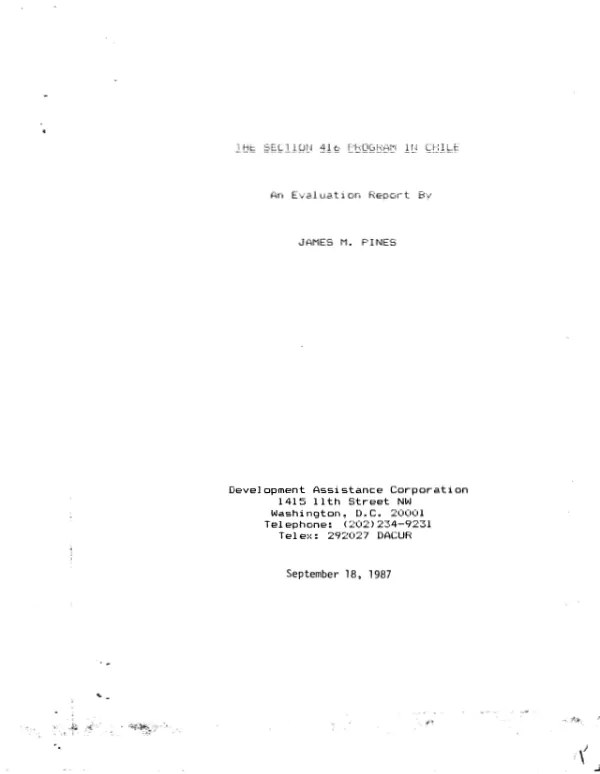
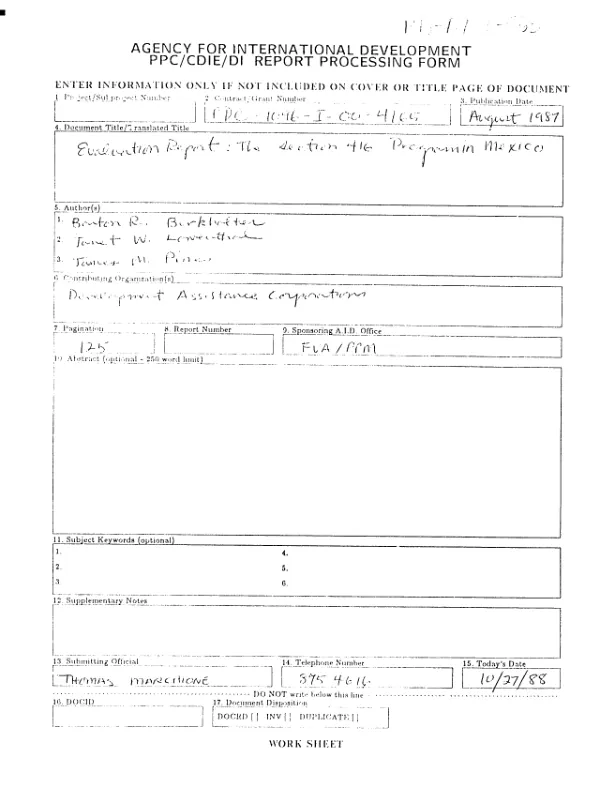
Evaluation report : the section 416 program in Mexico
Evaluates Food for Peace (FFP) program conducted in Mexico under Section 416 of the Agricultural Assistance Act.
Burkhalter, Barton R.|Lowenthal, Janet W.|Pines, James M. · 1987
Sign in to readA free account is required to download.
Abstract
External evaluation covers 10/83-6/87 and is limited to FFP activities of the Mexican national social welfare agency (DIF) and Mexican PVO's. An FFP officer's 6/86 allegations of program mismanagement created undue alarm and lack of confidence in the A.I.D./M Representative and the program. As a result, A.I.D./W increasingly and often unjustifiably delayed approval of project proposals, and the U.S. Department of Agriculture abruptly terminated milk availability in 2/87, thus temporarily suspending some projects and damaging program effectiveness. Nonetheless, the program exemplifies outstanding use of surplus commodities to alleviate the effects of structural adjustment on poor people and to demonstrate an advanced developing country (ADC) strategy. PVO's supervise milk distribution to more than 1 million recipients at over 1,500 locations, while the DIF distributes food to about 3 million people at 2,000 sites. Generally well-targeted to poor families and oriented toward self-help, the projects mitigate dependence, encourage local production, and provide incentives for use of family planning, health, and other services. Developmental outcomes have included an impressive mobilization of private funds and volunteers, institutional rehabilitation of DIF, and linking of private and governmental entities in a joint effort. Participating Mexican PVO's have improved effectiveness, strengthened development programming, broadened coverage and volunteer activity, and mobilized new donors. Achievements are greatly due to key individuals, particularly the DIF director, the A.I.D./M Representative, and the FEMAP (St. Mary's Food Bank) leader. Although current impact seems likely to endure, eventual turnover of these leaders, in addition to national political and economic uncertainties, make the program's future unclear. Several lessons were learned. (1) FFP needs a new approach for Mexico and probably for other ADC's. A.I.D./M, DIF, and the Mexican PVO's merited a confidence that FFP frequently failed to give. (2) Unless USDA can assure specific quantities on a multi-year basis, Section 416 projects are best limited to short-term budget or incentive support. Even with a minimum guarantee, projects relying exclusively on one commodity, such as milk, involve unacceptable risks of irregular supply. (3) Even temporary projects require commitments from local governments and PVO's that cannot be reversed quickly. Sponsors and beneficiaries need at least 18-24 months notice of termination. (4) Although conversion of the Mexico program to FFP Title II would assure multi-year commodity availability, it would also institutionalize food aid in a country which, with the resumption of economic growth, will not need it.