PLANNING ASSISTANCE
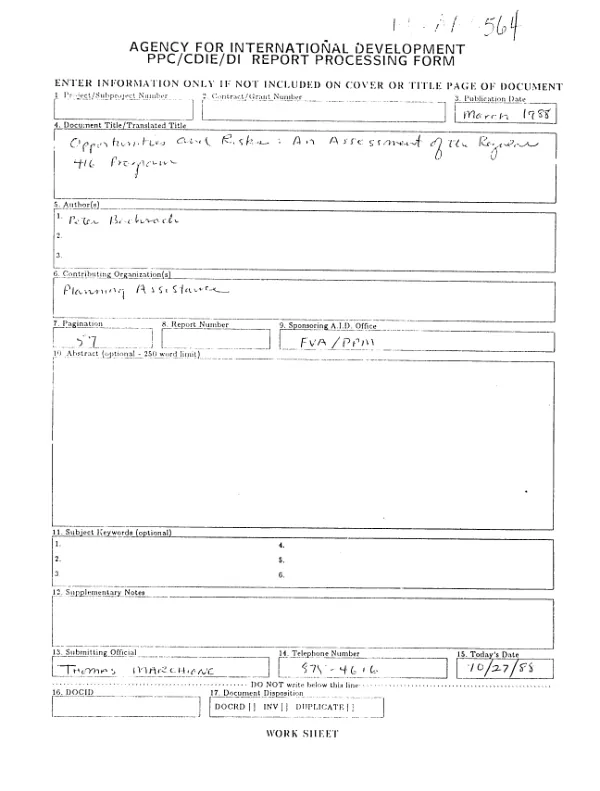
Opportunities and risks : an assessment of the regular 416 program
Evaluates food assistance provided under Section 416 of the Agricultural Assistance Act.
Bachrach, Peter · 1988
Sign in to readA free account is required to download.
Abstract
External evaluation covers the period 1982-9/87. Charged with the dual objectives of reducing surplus U.S. food stocks and feeding needy persons overseas, the Section 416 program has donated almost 800,000 MT of surplus commodities through some 70 cooperating sponsors in 33 different countries since its initiation in 1982. Despite inherent problems, the program has achieved solid results. It has: measurably improved the nutritional status of certain vulnerable populations; helped to mobilize existing resources, as well as to generate additional resources over and above the value of the donated commodities; strengthened participating local institutions; and increased the productive capacity of beneficiaries both directly (through income-generating activities, family gardens, etc.), and indirectly (through health-related activities, school feeding, etc.). Problems have stemmed principally from the difficulties of implementing a constantly evolving legislative mandate. Major legislative changes in 1984 and 1985 have decreased the program's flexibility and increased the time required for project approval. Interagency dissent has also impeded implementation: A.I.D. and the U.S.D.A. have disagreed persistently on matters concerning resource allocation, program emphases, and control. Beginning in 1986, these problems have been exacerbated by a lack of milk availability and general instability of commodity supply. In general, management deficiencies have been more serious in Washington than in the field. The major problem at the field level has been the danger of program assistance increasing recipients' dependence on food aid. Steps are being taken to address both types of problems. It is recommended that the program target countries that have a social services tradition or infrastructure, clear priorities for target groups, resource mobilization capability, and committed embassy or USAID staff. Participating sponsors should have field experience, links with other sponsors, and sufficient resources. Project proposals should include beneficiary selection criteria, rational implementation alternatives, and a phase-out or termination plan; the issue of dependence should be explicitly addressed. Other suggestions are to: prohibit sponsors from altering their normal activities to accommodate 416 commodities (sponsors should be capable of absorbing commodities on a windfall basis); ensure that project-level objectives are commensurate with the program's limitations; introduce some form of yearly fiscal planning; improve proposal review and approval procedures; adopt alternatives to the present commodity allocation system; and improve communication with the field.
Related documents