USAID. MISSION TO COSTA RICA
Evaluation study of the urban employment and community improvement project
Evaluates project to institutionalize an urban employment and community development program in Costa Rica.
Lombardo, Joseph F. · 1981
Sign in to readA free account is required to download.
Abstract
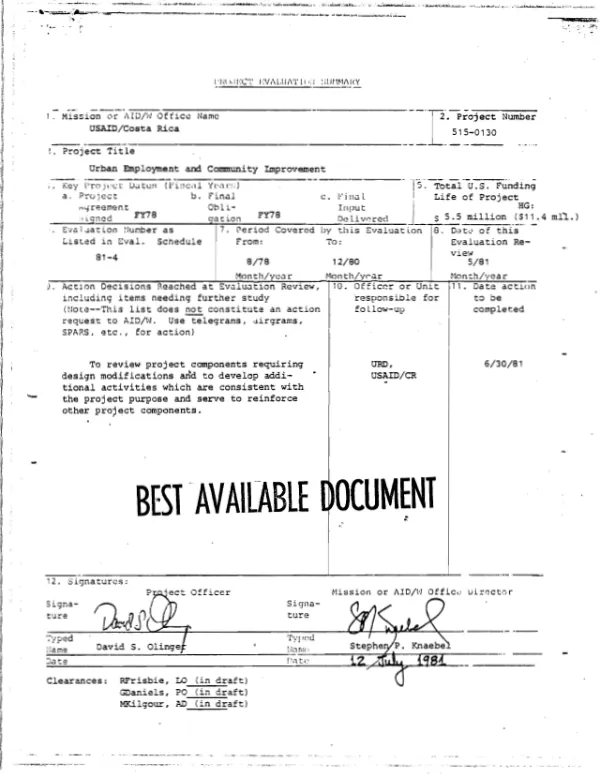
Evaluation covers the period 8/78-12/80 and is based on document review, site visits and interviews with project personnel. For a quantitative account of project progress, see the attached PES (PD-AAJ-239). The job training and job placement (JP) programs have been hampered by inadequacies in government inter-agency coordination, trainee selection, participants" work attitudes, and by lack of private sector awareness of the program. Unexpectedly, informal JP programs have been more effective than those of the project. The small business (SB) development and job creation programs are proceeding, albeit slowly. The credit and technical assistance program for SB"s has been hampered by commodity delays, low salaries that have only attracted untrained staff; departure of trained staff to obtain better jobs; and restrictive loan criteria. A.I.D."s Productive Credit Guarantee program has enabled SB"s lacking collateral to enter the loan program. The ratio of jobs created to dollars invested is well below projected levels. The housing development project has had problems with a lack of government interest in housing and by municipality concern that the projects would turn into slums. With government commitment to the programs, however, progress is now being made. Infrastructure development has been paralyzed by the requirement that l00% of costs be recuperated. It is recommended to: extend the project 2 years to allow the JP component to be redesigned in light of studies on target population, the business community, and the economy; restructure the employment component to meet increasing demand and solve its personnel and vehicle problems; implement the housing component separately from the infrastructure component and resolve the latter"s cost recuperation problem; streamline project coordination; and make project outputs, purpose, and goal more realistic and continue A.I.D. technical assistance for this effort. It is strongly recommended in future to make each component a separate project within an integrated strategy so as to improve inter-agency coordination.
Related documents