USAID. MISSION TO COSTA RICA
Urban employment and community improvement
Evaluates project to institutionalize an urban employment and community development program in Costa Rica.
Olinger, David S. · 1981
Sign in to readA free account is required to download.
Abstract
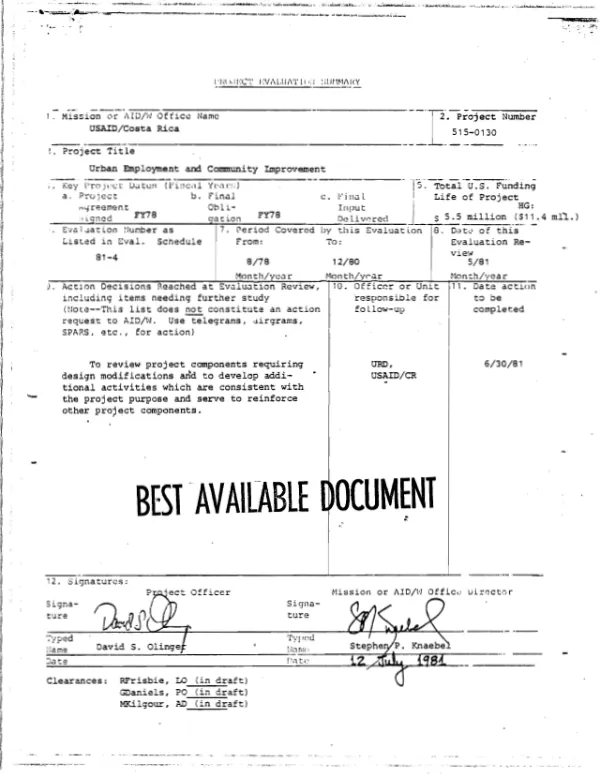
Evaluation, which summarizes an attached special evaluation (XD-AAJ-239-A), covers the period 8/78-12/80. With the project over 50% complete, progress has been slow and achievement of all objectives by the completion date is unlikely. Only 436 and 64 people have received pre-job and on-the-job training, of respective targets of 3,000; and only 367 of a planned 8,000 workers have been placed. A total of 204 small business (SB) have received $715,000 in credit, against targets of 970 and $5.8 million; and only 320 of 3,500 SB jobs have been created. Business skills training has fared better, with 461 of 800 SB owners and managers completing courses at the National Training Institute (INA). Design and feasibility work for the worker-owned/operated firms is in process. Due to the National Housing and Urban Development Institute's (INVU) aversion to the sites and services approach, the shelter program is still being planned, and the Institute for Muncipal Administration (IFAM) has found valorization unworkable as a cost recovery method for the community infrastructure program. However, repeated land invasions and a deteriorating fiscal situation have caused INVU and the Ministry of Housing to begin to show interest in the two programs. Offices have been set up for the urban policy, planning, and administration component, but systematic operational procedures are still evolving. Housing and interest rate studies are underway, and a contract is being negotiated for a plan to expand the project to secondary cities (preferably by developing individual plans). However, due to poor leadership in the Evaluation Unit of the National Planning Office, no evaluation targets have been completed. Failure to collaborate with host country institutions at the design stage, a delay in purchasing vehicles for the Ministry of Economy's Small Industry Unit, and government reluctance to spend other than what is necessary have also slowed implementation, resulting in as much as $1.25 million of project funds available for reprogramming. USAID/CR will modify or add to the project in a way consistent with project objectives.
Related documents