USAID
Evaporative Cooling Technologies for Improved Vegetable Storage in Mali
Evaporative cooling technologies have been explored as a means to improve vegetable storage in Mali.
2018 · 45 pages
Sign in to readA free account is required to download.
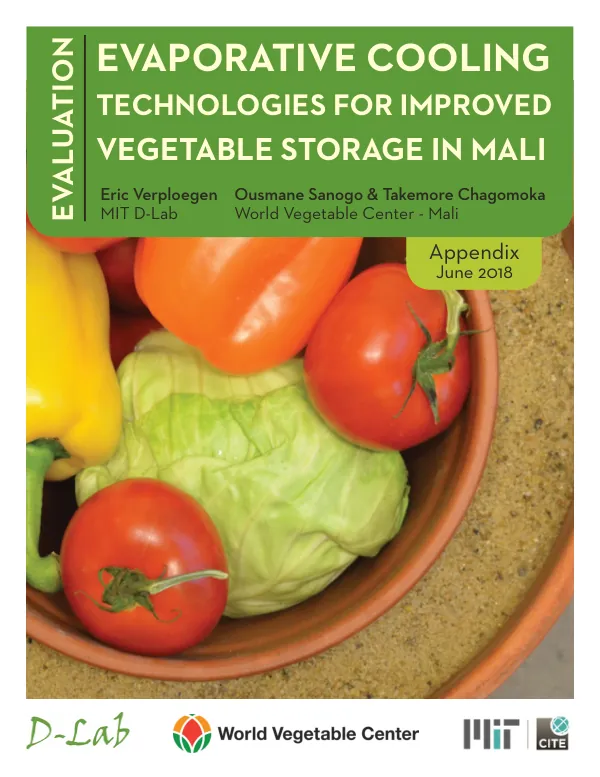
Abstract
The World Vegetable Center, in collaboration with MIT D-Lab, conducted a study to evaluate the effectiveness of evaporative cooling chambers (ECCs) and clay pot coolers in maintaining vegetable shelf life. The research was conducted in Mali, a country with a dry desert-hot summer climate, which is ideal for evaporative cooling. The study involved the procurement and assembly of ECCs and clay pot coolers, as well as the selection of study participants and data collection. The World Vegetable Center led the fieldwork, while MIT D-Lab contributed to the research design, data analysis, and preparation of the report. The study was made possible in part through financial support from the United States Agency for International Development. The ECCs were constructed using different materials, including brick, straw, and sacks, and were designed to provide a controlled environment for vegetable storage. The clay pot coolers, on the other hand, were made using traditional materials and were designed to be low-cost and easy to construct. The study aimed to evaluate the effectiveness of these technologies in maintaining vegetable shelf life and reducing post-harvest losses. The study used a combination of field observations, group interviews, and data collection to evaluate the performance of the ECCs and clay pot coolers. The data collection tools included a checklist for group interviews, a cooperative ECC interview, and a household interview for clay pot coolers. The study also used sensors to collect data on temperature, humidity, and soil moisture levels. The results of the study showed that the ECCs were effective in maintaining vegetable shelf life, with an average increase of 10-15 days compared to traditional storage methods. The clay pot coolers also showed promise, with an average increase of 5-10 days in vegetable shelf life. The study also found that the ECCs were more effective in maintaining vegetable quality, with lower levels of spoilage and decay. The study's findings have implications for vegetable storage in Mali and other countries with similar climates. The use of evaporative cooling technologies can help to reduce post-harvest losses and improve food security, particularly for small-scale farmers who rely on traditional storage methods. The study's results also highlight the importance of considering the local climate and cultural context when designing and implementing new technologies. The study's methodology and results are presented in detail in the report, which includes figures, tables, and appendices that provide additional information on the study's design, data collection, and analysis. The report also includes a discussion of the study's limitations and recommendations for future research.