USAID
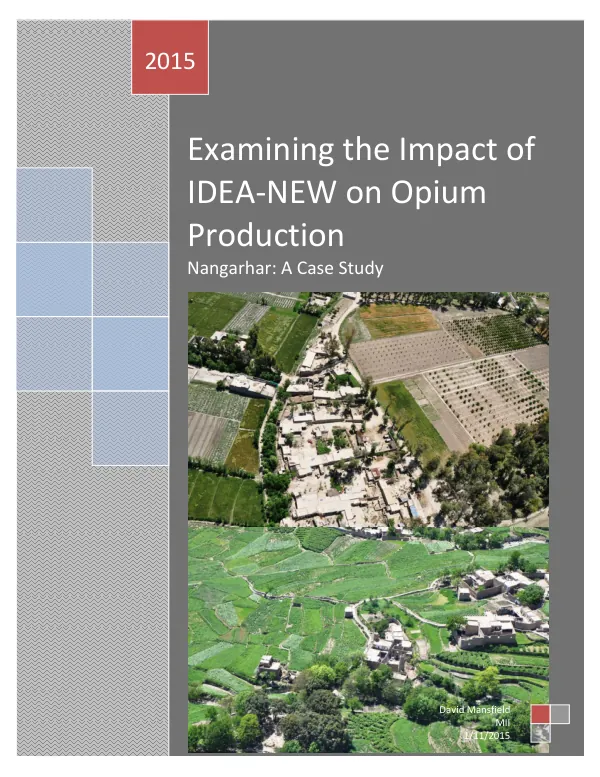
Examining the Impact of IDEA-NEW on Opium Production: Nangarhar: A Case Study
The USAID Incentives Driving Economic Alternatives for the North, East and West Program (IDEA-NEW) was a US$ 159.88 million rural development program that ran from March 2009 to March 2014.
2015 · 124 pages
Sign in to readA free account is required to download.
Abstract
The program aimed to increase agricultural production, rural enterprise, and related infrastructural development, access to financial services, and overall value-chain development and integration for key regional industries. IDEA-NEW was almost entirely funded from the Alternative Development budget of USAID and fell under the responsibilities of the office of agriculture in Kabul. The program's primary goal was to dissuade farmers from growing opium poppy by increasing access to licit, commercially viable alternative sources of income. However, an audit by the Office of Inspector General (OIG) of USAID in June 2012 reported that IDEA-NEW was unable to provide evidence of the program's contribution to reducing poppy cultivation. This evaluation was designed to examine IDEA-NEW's contribution to reducing opium poppy in Nangarhar province in eastern Afghanistan. Nangarhar was considered a primary interest due to its history of entrenched opium poppy cultivation, which had been successfully eliminated in the growing season prior to the start of IDEA-NEW. The province was declared 'poppy free' by UNODC, and Nangarhar was viewed as a 'model' province from both a counternarcotics and counterinsurgency perspective. However, since 2010, the operational environment in Nangarhar has changed dramatically, with security following a downward trajectory. IDEA-NEW responded to the worsening security situation by moving away from direct implementation and presence in the southern districts where opium poppy is concentrated. Instead, the program focused on supporting value chains and businesses that could operate in chronically insecure rural areas. This led to a focus on 36 different businesses in Nangarhar, of which half are purchasing agricultural produce to a value of US$ 1.4 million per annum, and the other 18 businesses are inputs suppliers selling around US$ 4.4 million of seeds, fertilizers, pesticides, and agro machinery across Nangarhar each year. The counternarcotics effort and its impact on segments of the rural population have been catalytic, providing a stimuli for rural resistance and insurgency in the southern districts. The weaknesses of the Afghan state were fully exposed to the rural population following the failed eradication campaign in Sherzad in the spring of 2010 and the protracted land dispute in Achin that began around the same time. By 2011, Governor Gul Aga Shirzai's reputation as a man of action was in ruin, and the political settlement between the provincial political leadership, the rural elite, and the population that had successfully underpinned the early years of Gul Aga Shirzai's leadership was no more. The evaluation of IDEA-NEW's contribution to reducing opium poppy in Nangarhar province will examine the program's impact on livelihoods, agricultural production, and rural enterprise. The evaluation will also assess the program's ability to build resilience to the opium ban and its contribution to reducing opium poppy cultivation in the province.