USAID. MISSION TO MAURITANIA
Expanded program of immunization; evaluation report
Evaluates project for an expanded program of immunization (EPI) to vaccinate 80% of Mauritanian children aged 0-5 against communicable diseases by 1985.
1982
Sign in to readA free account is required to download.
Abstract
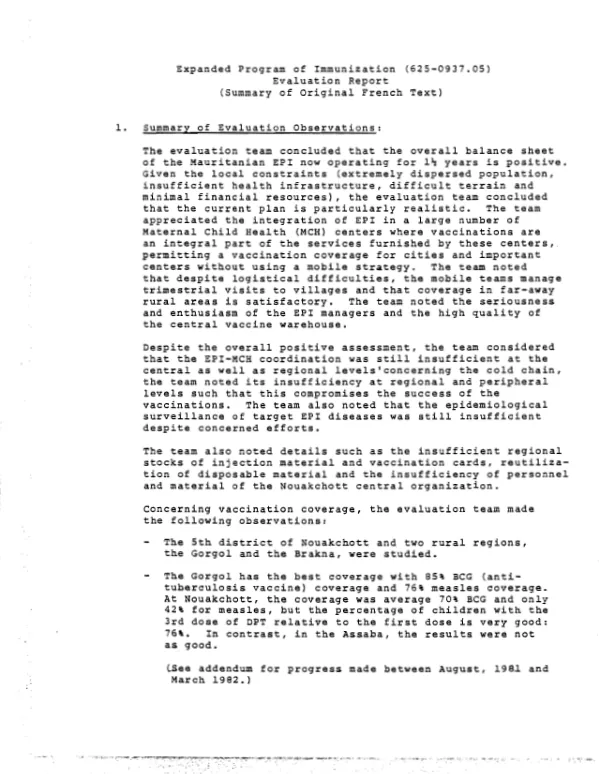
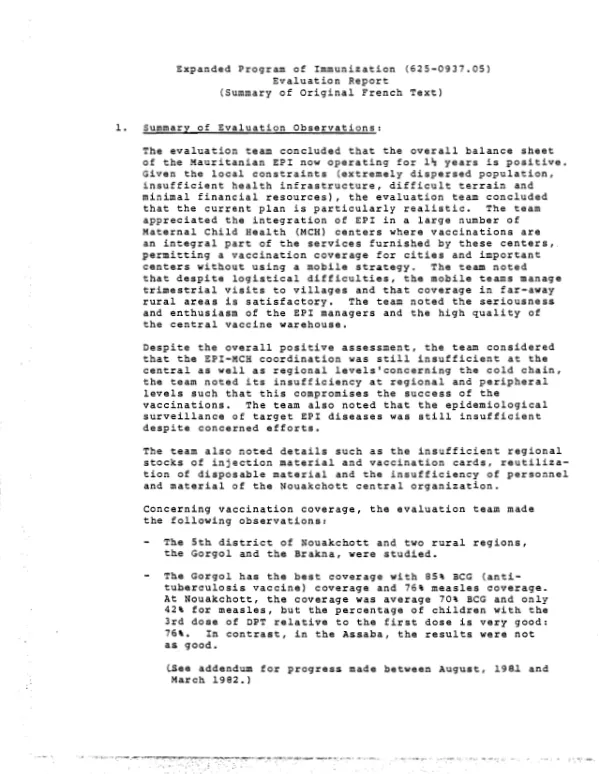
Special evaluation by a Mauritanian/multi-donor team covers the period 7/80-7/82 and is based on document review and site visits. Given local constraints (e.g., dispersed populations), results have been positive. Of the three regions visited, coverage was best in Gorgol, with 85% vaccinated against tuberculosis (TB) and 76% against measles and with 86% having received the first anti-polio shot. However, only 39% had received the third anti-polio shot and only 29% are completely vaccinated. In Nouakchott, measles coverage is only 42% - too low to retard endemicity - and only 27% are completely vaccinated. Assaba had the poorest record, with only 16% having received the third anti-polio shot and only 14% completely vaccinated. Measles coverage was good (52%), although non-heat-stable vaccine proved ineffective in one village (only heat-stable vaccine is now used in Mauritania). Anti-TB injections left scars on only 77% of Assaba children, compared to 92% in the other two regions. Nomads, although constituting 37% of the Assaba population, could not be included in the survey. Major problems include the insufficiency of EPI-Maternal/Child Health (MCH) cold chain coordination and of epidemiological surveillance of target diseases - despite efforts on both counts. Other problems include inadequate regional stocks of injection materials and vaccination cards, the re-use of disposable material, and insufficient personnel and materials in Nouakchott's central organization. Eight recommendations are made to redress the project's shortcomings. As of 8 months afer the evaluation, two week-long seminars had been held for EPI staff on vaccination techniques, mobile team-MCH center cooperation, and EPI reporting; a standardized reporting system was developed for health units; and Mauritania was in the process of establishing a multisectoral health education commission, a plan of studies and ongoing evaluation, and a program to redesign its EPI.
![Wawa sana [healthy child] : mobilizing communities and health services for community-based IMCI [integrated management of childhood illness] -- testing innovative approaches for rural Bolivia : report of the Bolivia CS-16 midterm evaluation](https://covers.devme.ai/gen/5361.webp)