USAID. MISSION TO MAURITANIA
Expanded program of immunization
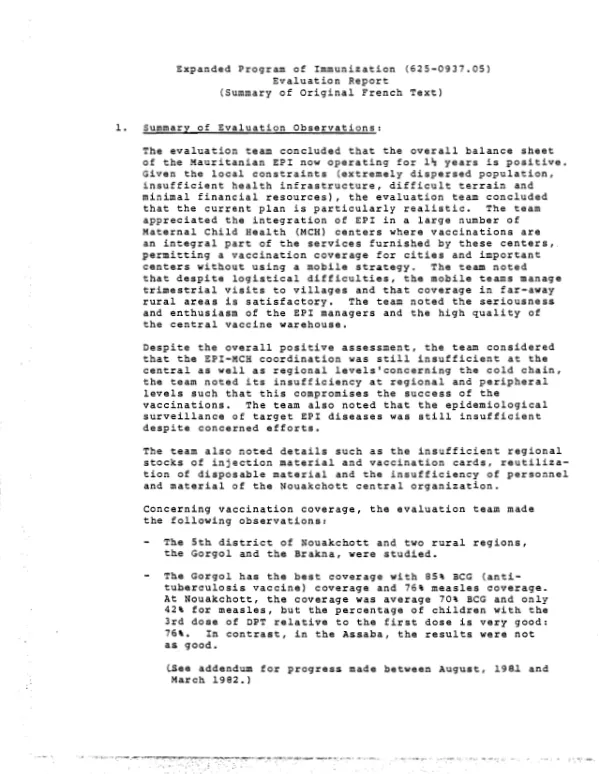
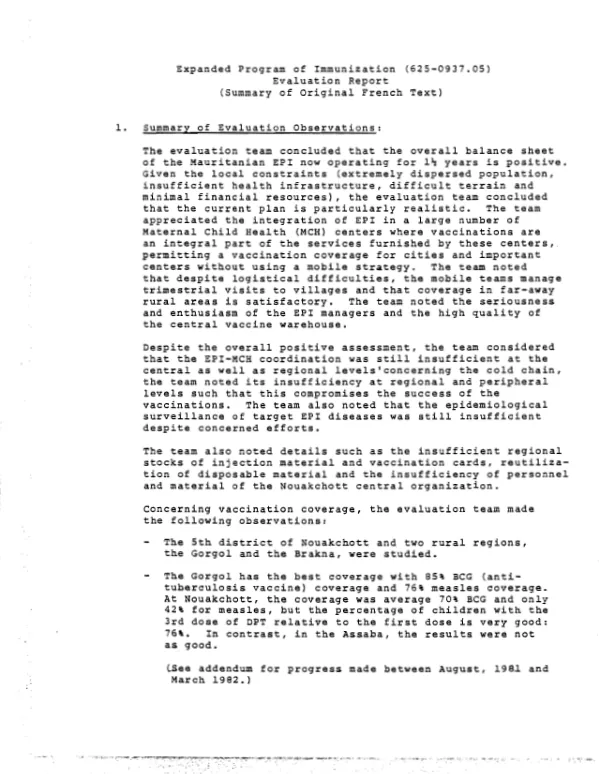
Evaluates project for an expanded program of immunization (EPI) to reduce the incidence of communicable diseases among Mauritanian children aged 0-5 yrs.
Neuhauser, Linda; Mahmoud, Mohamed · 1982
Sign in to readA free account is required to download.
Abstract
PES covers the period 7/80-7/82 and is based on an attached special evaluation by a Mauritanian/multi-donor team (XD-AAL-551-A). The project has fulfilled its stated purpose - the incidence of measles and pertussis has already been notably reduced - and continues to solve problems and expand its impact. One region essentially without population (Tiris Zemmour) was deleted from the schedule. The goal of inoculating 70% of an estimated 300,000 children under 6 is being met. Since vaccines to be funded by USAID/M were donated by the UNICEF, A.I.D. money was reallocated to purchase a vaccine warehouse, generator, and other commodities. An unplanned effect of the project was its selection as a central vehicle for extending other rural health services (tuberculosis and leprosy control, primary health worker supervision, health education delivery, and endemic disease control), resulting in low cost per beneficiary and high impact on health. The project demonstrated the feasibility of a national vaccination program despite major constraints and the need to foresee program integration problems. The project also taught that a specific technology (immunization) is easier to implement than other health programs and that management tools (such as computerized data) need to be developed early for project surveillance and control, especially for rigorous central/regional vaccination control. Epidemiological surveys were found to be important, and evaluations necessary for timely problem resolution. Mauritania"s initiative and management of this project using multi-donor resources has been a key to the project"s success. Action decisions are to: improve the integration between mobile teams and the immunization control centers through joint training seminars; test the standardized health information system already developed; train 2-3 Mauritanians in equipment (cold chain, generator) repair and maintenance; establish a Health Education Commission with an EPI component; and develop a 5-year plan for EPI continuation.
Related documents