USAID DEC
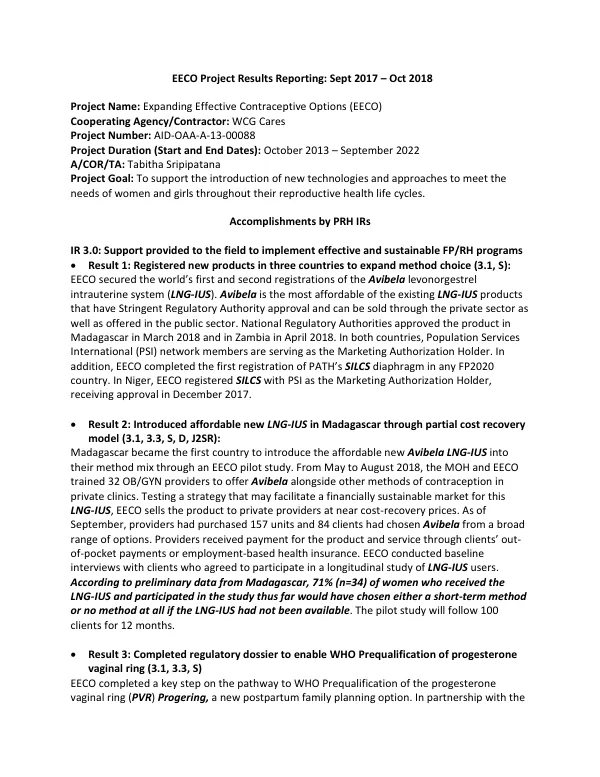
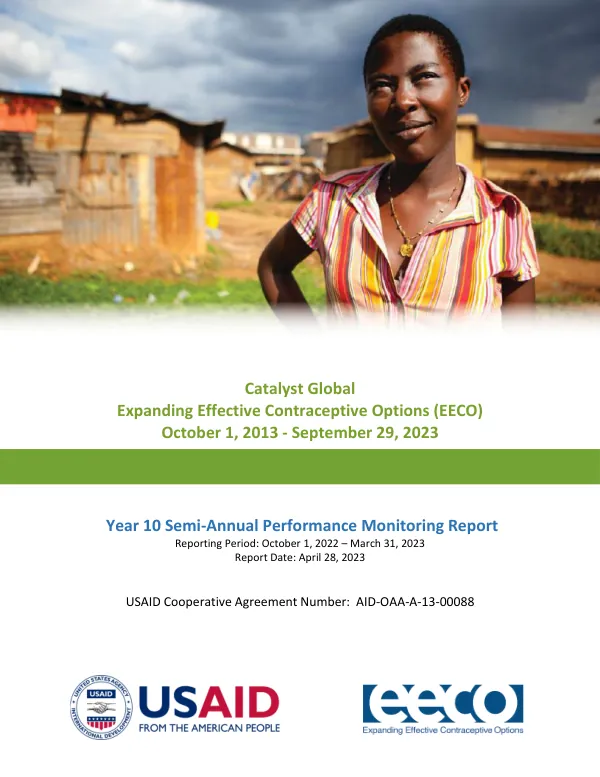
Expanding Effective Contraceptive Options (EECO) Project Results Reporting: Oct 2020 – Sept 2021
Sign inFHI 360
Expanding Effective Contraceptive Options (EECO) Project Results Reporting: Oct 2020 – Sept 2021
The Expanding Effective Contraceptive Options (EECO) project aimed to support the introduction of new technologies for voluntary family planning to meet the needs of women and girls throughout their reproductive health life cycles.
2021 · 4 pages
Sign in to readA free account is required to download.
Abstract
The project was implemented by WCG Cares under the contract AID-OAA-A-13-00088 from October 2013 to September 2023. EECO demonstrated global leadership in family planning and reproductive health policy, advocacy, and services. The project disseminated evidence on the hormonal intrauterine device (IUD), contributing to global and national decisions to widen access. EECO's hormonal IUD studies provided evidence on the profiles of clients who choose this method in low- and middle-income countries, their reasons for choosing the method, and their continuation and satisfaction with the method after 12 months of use. The project also conducted a literature review on barriers and enablers influencing women's adoption and continuation of vaginally-inserted contraceptive methods. The review found common enablers for method adoption, including quality contraceptive counseling and alignment between a woman's preferences and a method's duration of use and side effect profile. Common barriers included a lack of familiarity with the methods and product cost. EECO led the first pilot introduction in sub-Saharan Africa of a novel, single-size contraceptive diaphragm in Niger. The pilot introduction was the culmination of decades of effort that began with USAID funding CONRAD and PATH to develop the new diaphragm. The project registered the Caya Diaphragm and accompanying Caya Gel in Niger and procured multiple shipments of both products. From June 2019 through September 2021, 1,596 women in Niger accessed kits that included the diaphragm and gel through 16 public health centers, 6 private clinics, and 8 community health workers. The COVID-19 pandemic continued to disrupt health programs across the world, and EECO took measures to mitigate its impact. The project postponed all international travel, delivered remote technical assistance, adjusted promotional activities, and paid higher-than-usual shipping costs to procure the Caya Diaphragm and Caya Gel for the pilot in Benin. EECO will continue to take measures to mitigate COVID-19 and reassess how to achieve project objectives in the face of ongoing challenges presented by the pandemic. EECO's findings contributed to decisions by the governments of Madagascar and Zambia to scale up the hormonal IUD nationally. The project's results also informed the analysis done by FHI 360, Avenir, and USAID in 2021 to update the Couple-Year of Protection for diaphragms. The project will continue to disseminate its results globally and prepare for future scaling up of access to the hormonal IUD and other contraceptive methods.
Related documents