USAID DEC
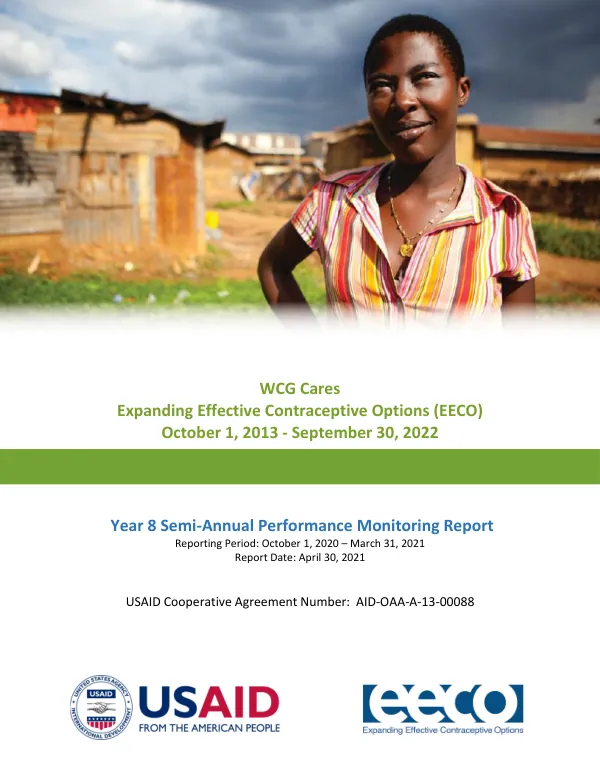
Year 10 Semi-Annual Performance Monitoring Report: Expanding Effective Contraceptive Options (EECO)
Sign inPOPULATION COUNCIL
Year 10 Semi-Annual Performance Monitoring Report: Expanding Effective Contraceptive Options (EECO)
The Expanding Effective Contraceptive Options (EECO) project, led by Catalyst Global, is designed to support the introduction of new or improved methods of voluntary contraception in United States Agency for International Development (USAID) partner countries.
2023 · 24 pages
Sign in to readA free account is required to download.
Abstract
The project focuses on four products: modern fertility awareness method (mFAM) apps, the hormonal intrauterine device (hormonal IUD), the Dual Prevention Pill (DPP), and the SILCS Diaphragm, also known as Caya. EECO's project dates span from October 2013 to September 2023, with Year 10 covering the period from October 1, 2022, to September 29, 2023. The project's Performance Monitoring Plan (PMP) indicators are listed in Appendix A. EECO works at multiple levels of the value chain, progressing through five stages of new product introduction, including learning, regulatory, distribution, and market creation. In the reporting period from October 2022 to March 2023, EECO made significant progress in introducing and scaling up the hormonal IUD in Madagascar and Tanzania. In Madagascar, EECO participated in a panel presentation at the International Conference on Family Planning (ICFP) and presented on the impact of their Catalytic Opportunity Fund (COF)-supported work to the Hormonal IUD Access Group. In Tanzania, a manuscript on the use of the East African Community - Medicines Regulatory Harmonization (EAC-MRH) program for registration of AVIBELA was submitted and accepted by a journal. EECO also made progress in introducing the Caya Diaphragm in Niger and Benin. In Niger, EECO presented results from Benin and Niger's introductions of Caya at ICFP and participated in MOH-led quantification workshops. In Benin, EECO partner Association Béninoise pour le Marketing Social et la Communication pour la Santé (ABMS) focused communication and distribution efforts on existing Caya diaphragm users, encouraging resupply of the Caya gel. ABMS communicated with 30,491 women and 4,250 men through awareness-raising efforts about FP methods, including Caya. EECO also developed a manuscript in French analyzing the results from the quantitative and qualitative operational research completed in 2021. The manuscript was submitted for review to the African Journal for Reproductive Health, but the editors no longer accept manuscripts in French. EECO is in the process of identifying a new journal to submit the manuscript. Additionally, EECO presented at ICFP and the International Social and Behavior Change Communication (SBCC) Summit, and submitted an abstract on the results of the Caya introduction in Benin for the annual Ouagadougou Partnership (OP) meeting. The project's progress in introducing and scaling up new contraceptive options has the potential to improve access to family planning and reproductive health services, particularly in low- and middle-income countries. EECO's work in Madagascar, Tanzania, Niger, and Benin demonstrates the project's commitment to supporting the introduction of new or improved methods of voluntary contraception.