USAID DEC
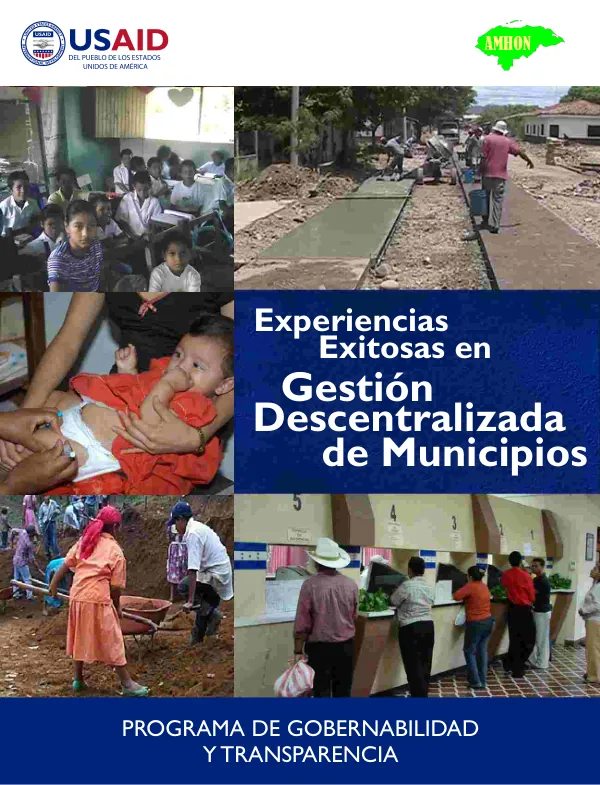
Experiencias Exitosas en Gestión Descentralizada de Municipios
The Programa de Gobernabilidad y Transparencia, a collaborative effort between AMHON and the USAID Honduras, presents a series of case studies on innovative administration and service delivery in six municipalities in Honduras.
115 pages
Sign in to readA free account is required to download.
Abstract
The studies cover various areas of municipal administration, including the reduction of time and complexity in municipal procedures, conflict resolution, alternative education services, inter-municipal health services, community-led urban paving, and rural road maintenance. In Honduras, as in most Latin American countries, the past three decades have seen a series of political reforms aimed at decentralizing government functions by transferring responsibilities and fiscal resources to municipalities. Initially, the debate on decentralization in Latin America focused on fiscal policy and local government financial performance. More recently, the debate has emphasized democratic governance practices at the local level and their impact on municipal management. Decentralization is argued to be a site for more effective governance, primarily because it creates opportunities for citizen participation and face-to-face interaction between citizens and government officials. The primary justification for decentralization is that it allows for greater public access to information on government activities and provides more information to officials and bureaucrats on citizen preferences. In Latin America, there is a considerable diversity in local governance practices. Common practices mentioned in studies and evaluations include direct election of municipal council members, public presence in council sessions, participation in consultative mechanisms for establishing plans and priorities, access to timely information on policies and actions, direct community participation in program implementation, citizen oversight and social auditing of government action, municipal ombudsmen, and the right to petition and complaint. These mechanisms give citizens a greater "voice." As a result, citizens give greater legitimacy to decision-making processes and decisions. To the extent that these practices of democratic governance are reinforced, decentralization contributes to the legitimacy and stability of the political system as a whole. However, this will depend primarily on the will of citizens, civil society organizations, political parties, and elected and non-elected officials in each municipality. It will also depend on their capacity to strengthen elected councils, improve transparency and access to information, create opportunities for greater participation in decision-making, make municipal managers more accountable to the corporation, and increase the effectiveness of municipal policies and programs. In this regard, there have been advances and setbacks. In many Honduran municipalities, there is a vibrant local democratic culture marked by competitive electoral politics; in others, there has been little alternation in political power over the past 25 years. In some municipalities, mayors and councils practice openness to citizen participation in decision-making; in others, they have been criticized for a lack of transparency. In this country, numerous small municipalities have significantly strengthened their capacity to manage resources and improve the quality of services; others still lack basic administrative, financial management, and service delivery capacities. While it is necessary to consider the limitations of decentralization in Honduras, it is also important to recognize these real advances in municipal capacities. Thinking strategically, to advance a national policy reform agenda in favor of decentralization, it is always useful to show leaders and public opinion real examples of how municipal governments can improve their administration and the quality of their services, using their tax resources more effectively and efficiently. This is the purpose of the case studies of best practices presented here, to show the great potential of municipal governments to meet the needs of their communities. All case studies have in common the search for strategies to reduce the costs of services and increase their effectiveness, maximizing the impact of their scarce resources. They are powerful because they demonstrate a positive and realistic vision of the possibilities of decentralization in Honduras. The case studies presented include: - The health services provided by MANCORSARIC, which offer the possibility of covering the health needs of several municipalities, achieving economies of scale, and reducing the potential overlap of coverage. - The pre-school and primary education services provided by the Municipality of Catacamas, which mobilize community resources and voluntary contributions to offer a low-cost alternative to families in rural areas. - The conflict resolution center in Las Vegas, which uses both municipal paid staff and community volunteers to provide services to families and individuals in this municipality and adjacent municipalities. - The "single window" implemented in Comayagua, which reduces the time citizens and entrepreneurs spend on routine procedures with the municipality. - The paving system developed in Choluteca, which mobilizes community contributions to significantly reduce the costs of paving city streets. - The mobilization of rural communities to provide low-cost labor for rural road maintenance in Yamaranguila, which has given distant communities access to services in the capital and opportunities to bring their products to market. Each case study includes information for contacting municipal officials and staff responsible for implementing programs and projects. It is expected that other municipalities will take these ideas, transform them, and improve them. This is one of the paths to follow to maintain and deepen the decentralization process.
Related documents