USAID. BUR. FOR SCIENCE AND TECHNOLOGY. OFC. OF RURAL AND INSTITUTIONAL DEVELOPMENT
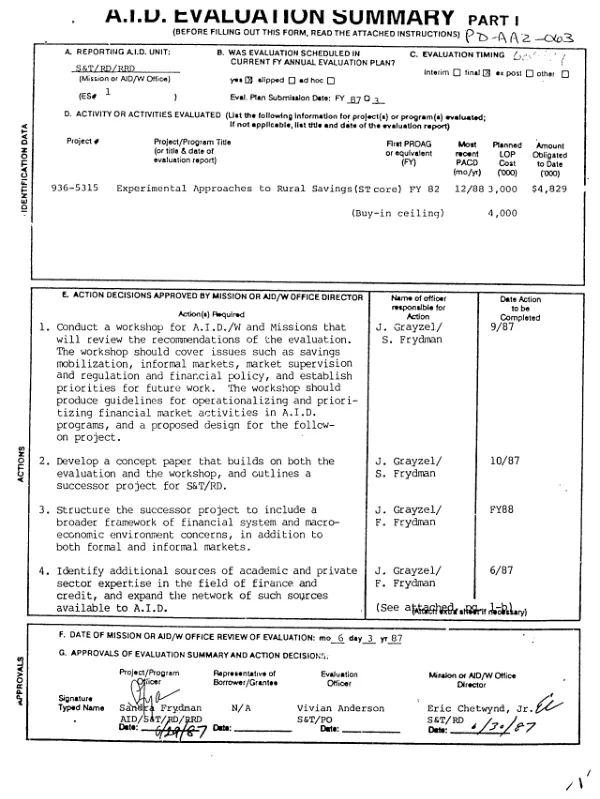
Experimental approaches to rural savings (ST core) FY 82 (buy - in ceiling)
Summarizes final evaluation (PD-AAW-992) of the Experimental Approaches to Rural Savings (EARS) project.
1987
Sign in to readA free account is required to download.
Abstract
Evaluation covers the period FY82-12/88. The initial purpose of EARS was to demonstrate the potential of mobilizing rural savings in LDC"s, thereby increasing the availability of financial capital for improving economic circumstances, particularly for small borrowers. As the project evolved, its purpose expanded to encompass a broader range of financial market needs, including financial sector development and improved viability of financial institutions. Consonant with this expanded purpose, the project provided TA for improving administration, credit allocation, and training. The ultimate goal became to assist Missions in mobilizing rural savings, in providing a range of financial services to rural areas, and in improving the viability of rural financial institutions. Major findings are: (1) EARS has demonstrated the potential for rural savings mobilization in certain countries. (2) EARS research supports the thesis that saver-dominated financial institutions show lower loan delinquency, greater efficiency, and greater viability; and that loan targeting increases lender costs, imposes significant transaction costs on participants in financial markets, and contributes to loan delinquency. (3) EARS has underscored the importance of the macroeconomic environment to the viability of financial institutions and to the success of rural financial market (RFM) projects. Recommendations include: (1) develop a follow-on project; (2) continue to support financial reform and development as well as research on rural financial institutions; (3) continue to promote financial sector policy dialogue; (4) encourage Ohio State University (the implementing agency for EARS) to assist local rural financial organizations in using proven concepts and methodologies; and (5) support additional research on urban and rural entrepreneurial financial needs, formal and informal financial sector integration, and broader financial sector policy issues. See also abstract of PD-AAW-992. (Author abstract)
Related documents
![Financial sector restructuring (FSR) project assistance [and] financial sector restructuring (FSR) non-project assistance](https://covers.devme.ai/gen/20893.webp)