USAID DEC
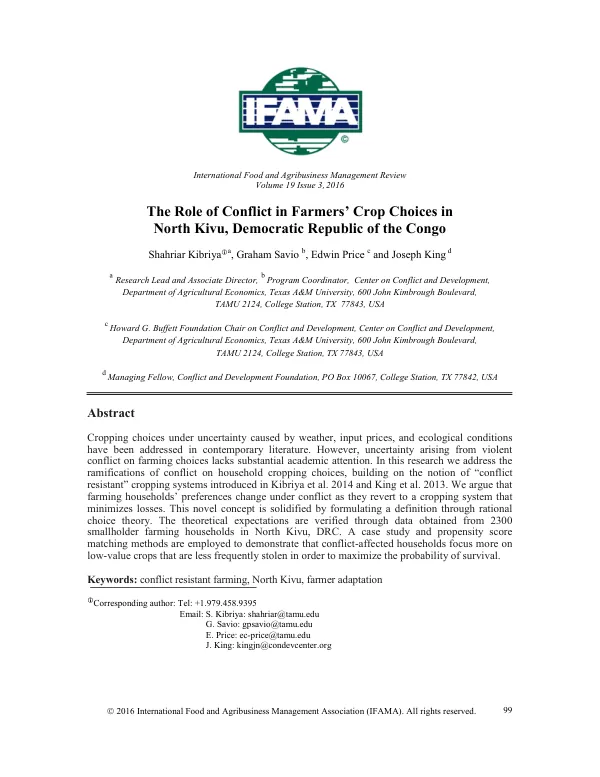
Explaining Cropping Choices under Extreme Uncertainty: Evidence from Conflict Prone North Kivu, DR Congo
Sign inTEXAS A&M INTERNATIONAL UNIVERSITY
Explaining Cropping Choices under Extreme Uncertainty: Evidence from Conflict Prone North Kivu, DR Congo
Farming households in conflict-prone North Kivu, Democratic Republic of Congo, display rational behavior when making farming choices.
2015 · 2 pages
Sign in to readA free account is required to download.
Abstract
The level of exposure to conflict significantly influences their decisions, with households experiencing higher levels of violence adopting conflict-resilient farming practices and diversifying their crops more. This is evident in the cultivation of conflict-resistant crops, such as root crops and crops that households reported were never looted. The study found that increased exposure to social conflict increases the cultivation of conflict-resistant crops and crop diversification. Conversely, low access to markets and information, as well as the lack of contracts with buyers, reduces the cultivation of conflict-resistant crops and crop diversification. The results suggest that improving access to markets and information, as well as increasing social cohesion, can help farming households in conflict-prone agrarian societies adopt conflict-resilient farming practices. Regression analysis revealed that conflict level, market access, and contracts with buyers are significant determinants of conflict-resistant crop cultivation and crop diversification. Households with greater access to markets and information invest more in conflict-resistant farming practices and diversify more. However, households with contracts with buyers tend to grow less conflict-resistant food crops and diversify less, potentially due to the insurance provided by pre-determined contracts. The study also found that social empowerment has a mixed effect on conflict-resistant crop cultivation and crop diversification. Households with greater social empowerment grow less conflict-resistant food crops and diversify less. Further research is needed to determine the channel through which social empowerment may reduce the incentive to cultivate conflict-resistant crops or diversify more. The findings of this study have significant policy implications for improving the livelihoods of farming households in conflict-prone areas. Improving access to markets and information, as well as increasing social cohesion, can help households adopt conflict-resilient farming practices and cope better with the adverse effects of long-term conflict and social unrest.
Related documents