USAID
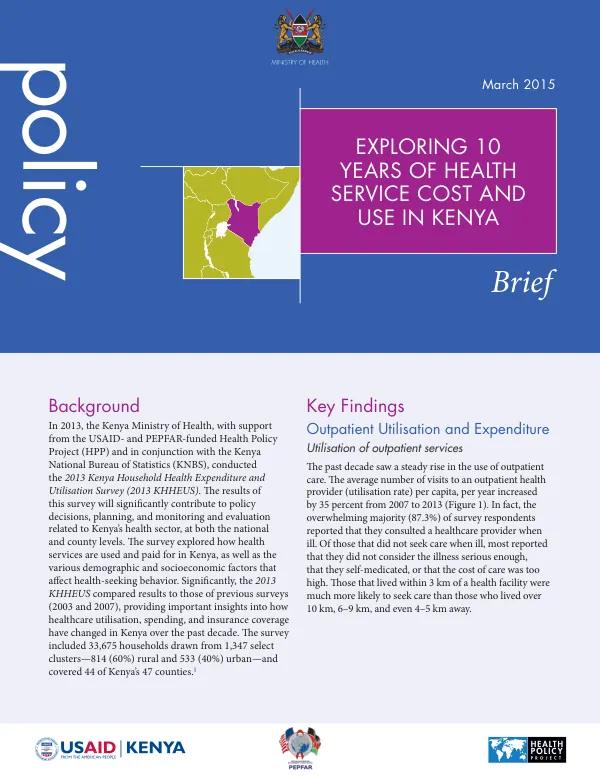
Exploring 10 Years of Health Service Cost and Use in Kenya
The Kenya Ministry of Health, with support from the USAID- and PEPFAR-funded Health Policy Project (HPP) and in conjunction with the Kenya National Bureau of Statistics (KNBS), conducted the 2013 Kenya Household Health Expenditure and Utilisation Survey (2013 KHHEUS).
2015 · 5 pages
Sign in to readA free account is required to download.
Abstract
The survey explored how health services are used and paid for in Kenya, as well as the various demographic and socioeconomic factors that affect health-seeking behavior. The survey included 33,675 households drawn from 1,347 select clusters, with 814 (60%) rural and 533 (40%) urban, and covered 44 of Kenya's 47 counties. The survey revealed a steady rise in the use of outpatient care over the past decade. The average number of visits to an outpatient health provider per capita, per year increased by 35 percent from 2007 to 2013. The overwhelming majority (87.3%) of survey respondents reported that they consulted a healthcare provider when ill. Those that lived within 3 km of a health facility were much more likely to seek care than those who lived over 10 km, 6-9 km, and even 4-5 km away. The youngest and oldest segments of the population (ages 0-4 years and 65 years and older) were the largest consumers of outpatient care. Wealthy individuals were more likely than the poor to consult a healthcare provider when ill, but the difference was minimal. Individuals with higher levels of education and those who resided in urban areas were more likely to seek care and utilise private providers than those with lower levels of education and rural dwellers. Females were more likely than males to seek outpatient care, and much more likely to get care at a public health facility. Private health facilities are becoming a major provider of outpatient services in urban areas, but Kenya is highly dependent overall on public facilities. In 2013, public health facilities accounted for over 58 percent of all outpatient visits. Out-of-pocket (OOP) spending on outpatient care rose from 2007 to 2013 to KSh 61.5 billion, with outpatient care accounting for approximately 78 percent of this figure (KSh 48.4 billion). Average annual per capita spending on outpatient care fell between 2003 and 2007, but rose again from 2007 to 2013, to KSh 1,254. Females, urban households, older segments of the population, and those with college and university educations spent the most on outpatient services. There was also considerable variation in outpatient utilisation and per capita spending between counties.