USAID DEC
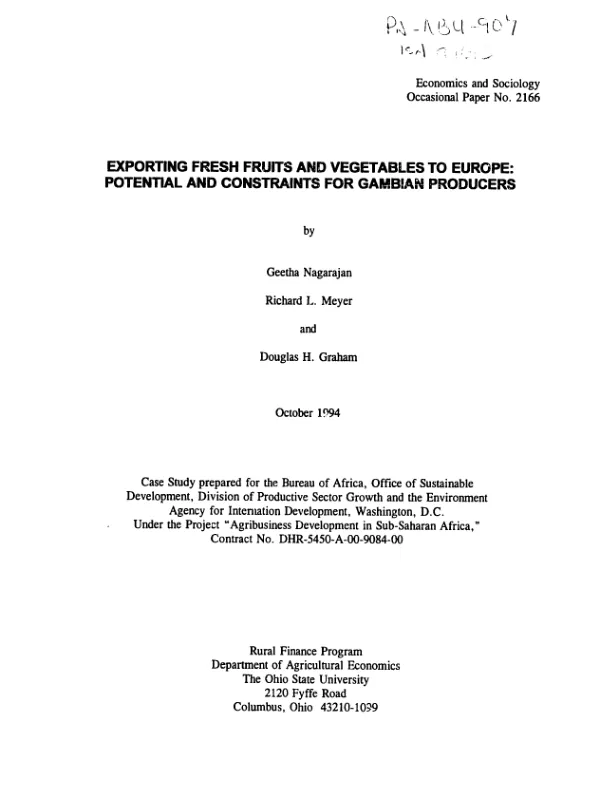
Exporting fresh fruits and vegetables to Europe : potential and constraints for Gambian producers
Sign inOHIO STATE UNIVERSITY. DEPT. OF AGRICULTURAL ECONOMICS AND RURAL SOCIOLOGY. RURAL FINANCE PROGRAM
Exporting fresh fruits and vegetables to Europe : potential and constraints for Gambian producers
The Gambia offers potential horticultural exporters a promising climate, a high water table, and good soil texture in peri-urban Banjul, along with relatively low-cost labor, remarkably good telecommunications, and close proximity to European markets.
Nagarajan, Geetha; Meyer, Richard L. +1 more · 1994
Sign in to readA free account is required to download.
Abstract
However, The Gambia"s ability to serve European markets is constrained by inadequate and cold storage facilities, lack of government support for research and extension, and information constraints, especially for small producers who cannot afford to travel to Europe. This mix of constraints and opportunities has created a horticulture sector comprised of a handful of big operators who have largely self-financed their entry into the European market, medium to small producers who are only able to sporadically export to Europe, and smaller producers, especially women"s groups, who produce exclusively for the domestic market. So far, formal financial sources have played only a minor role in financing the horticulture sector; in particular, small producers rely on self-finance or some informal sources of finance. Policies to facilitate development of this struggling sector should include support for Gambian entrepreneurs to attend marketing workshops in European countries, a joint venture to expand the planned cold storage facilities at the Banjul airport, more careful documentation of the flow of Gambian horticulture exports, development of improved crop varieties, and the improvement of horticultural labor safety conditions and wages. Most importantly, The Gambia is not likely to succeed in the European export market until it has had some years of experience supplying quality products to the domestic market.