USAID DEC
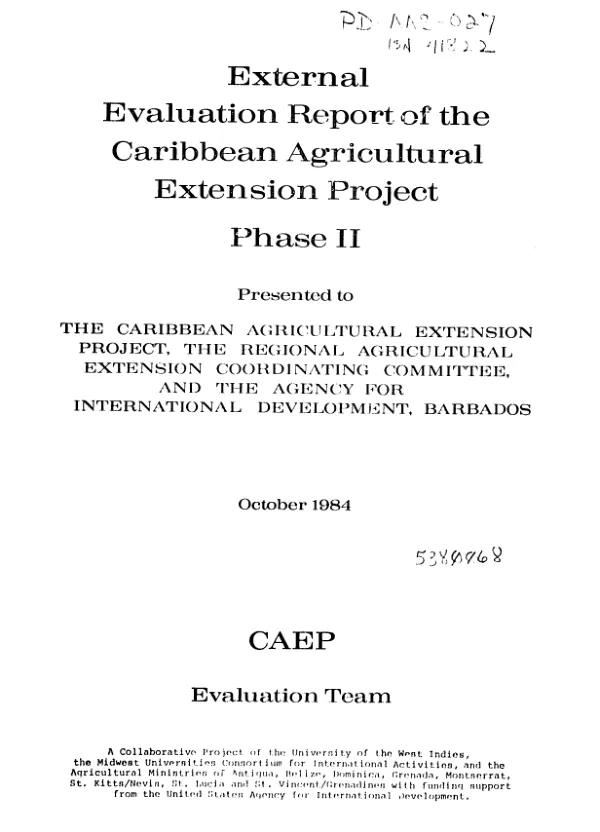
External evaluation report on the Caribbean agricultural extension project, phase II
Sign inUSAID. MISSION TO BARBADOS
External evaluation report on the Caribbean agricultural extension project, phase II
Evaluates project to upgrade agricultural extension (AE) in Antigua, Dominica, Montserrat, St.
Alkin, Marvin C.|Adams, Kay A.|West, Jerry · 1984
Sign in to readA free account is required to download.
Abstract
Kitts/Nevis, St. Lucia, St. Vincent, and Belize, as well as the University of the West Indies' (UWI) Department of AE. Special evaluation covers the period 1982-10/84 and is based on document review, 15 farmer case studies, and interviews with farmers and government, AE, project, private sector, and regional personnel. The project has made progress toward most goals, being especially effective in motivating ministry attention to, and administrative restructuring of, AE. National agricultural planning committees have been formed, job descriptions formulated, and communication lines, management procedures, and concrete work plans (the latter for national, district, and extension agent (EA) levels) developed in most countries. EA supervision has been strengthened through supervisor training, and performance and reporting standards. The establishment of a regional program to recognize outstanding EA's has helped increase professionalism and morale. AE continues to be hindered by lack of materials, transportation, and housing and by limited formal training of EA's, but the project has demonstrated potential for significant impacts on farmers (in, e.g., crop diversification and quality, and fertilizer/pesticide use); in 1984 farmer contacts increased by 50% over 1983. Although the project has significantly increased in-country and regional training opportunities, two key programs - Diploma in Agriculture and in Extension - have fallen short of expectations, the former plagued by lack of qualified candidates who intend to work in AE, the latter being too theory-oriented. Inservice communications training has helped compensate for weaknesses in the UWI communications course resulting from lack of equipment. While the project provided equipment and vehicles well suited to needs, delivery of these items was usually delayed. Project outreach staff have set a positive example through their hard work and dedication. Key needs include: better AE linkages with research, private associations, educational bodies, and marketing; strengthened regional AE efforts; better working relationships with CARDI; more vehicles for EA's; more attention to training and recruitment; and use of marketing information in planning.
Related documents