USAID. MISSION TO INDONESIA
Family planning development and services II (training component)
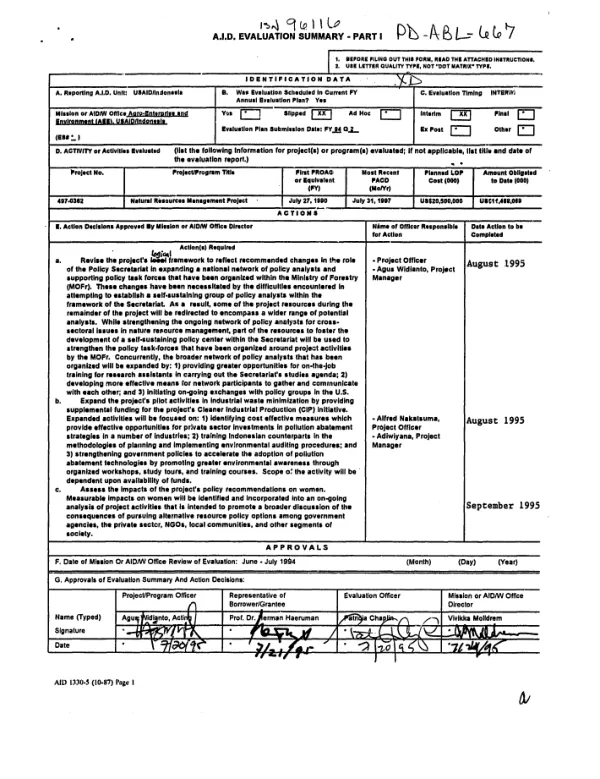
Summarizes attached external evaluation of training implemented by Indonesia"s National Family Planning (FP) Coordinating Board (BKKBN).
1986
Sign in to readA free account is required to download.
Abstract
Evaluation covered the period 1983-86 and was based on document review and interviews with participants, policymakers, administrative officials, and donor personnel. BKKBN trains about 60,000 people a year in long- and short-term programs, in-country and overseas. The two Centers for Education and Training (PUSDIKLAT) which coordinate and manage the training have successfully handled the problems of magnitude and diversity in BKKBN training. Staffing patterns, planning and budgeting cycles, program preparations, implementation, and evaluation are all uniform and systematized. From 1983-1985, the number of overseas academic trainees was more than the number for the previous 10 years. Further, the development and implementation of standard operating procedures and a computerized data base have substantially strengthened the management of overseas training. Problems were cited, however, with recruitment, selection, monitoring, and placement, with the training of foreigners in Indonesia and decreasing funding. However, the composition of trainees (the number of BKKBN staff trained and non-Jakarta based participants) is improving, as are the relevance of training and the education centers" administrative capacity. Recommendations are as follows: (1) PUSDIKLAT should strengthen its horizontal planning network and begin to formulate strategies to meet future training needs in the private sector. (2) Financial and administrative systems should be strengthened in PULAP (the Center for Education and Training for Civil Servants) and PUSDIKLAT should strengthen its training and evaluation systems. (3) Staffing deficiencies, particularly at PULNA (the Center for Education and Training for Program Personnel) should be corrected. (4) PUSDIKLAT should balance its dual role as implementor and coordinator of training. (5) Training for foreigners should be formalized, advertised, and a fee should be required. At least one BKKBN staff member should be assigned to manage this training. (6) To encourage qualified candidates, BKKBN should implement its set policy of graduate placement more effectively. (7) PULAP follow-up on long-term in-country participants who do not submit academic progress reports. (8) USAID/I should continue its TA to PULNA, but it and other donors should focus more on strengthening systems within the two training centers. (9) BKKBN should request donor support to continue long-term overseas training for specialized courses that Indonesian universities do not offer and for in-country Masters-level training. (Author abstract, modified)
Related documents