USAID. MISSION TO INDONESIA
Agro-enterprise and environment (AEE), USAID/Indonesia
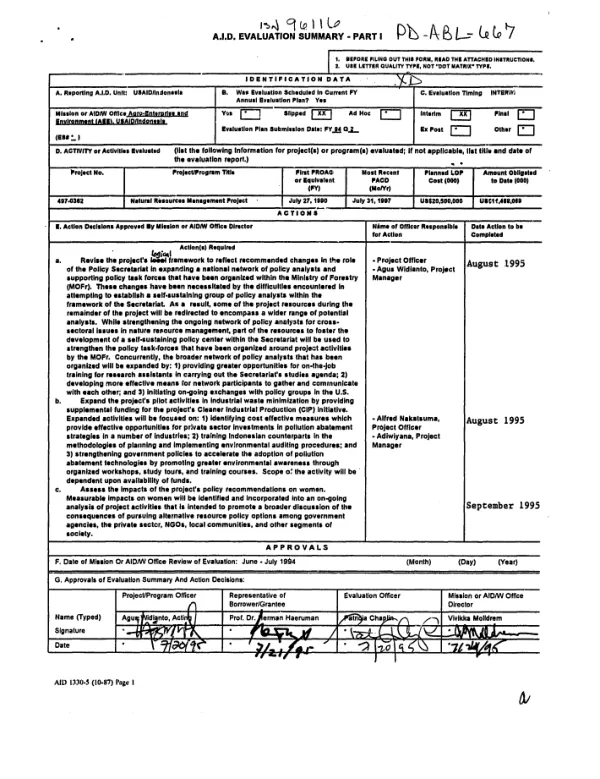
Summarizes attached mid-term evaluation (XD-ABL-667-A) of a project to improve policies and practices governing natural resource management (NRM) in Indonesia.
1995
Sign in to readA free account is required to download.
Abstract
The evaluation covered the period 7/90-4/95. Overall, achievements have been notable. An effective TA team is in place, 8 of 12 policy studies have been completed and widely disseminated, and the Ministry of Forestry has followed up on the policy studies by establishing task forces around project activities, including logging waste minimization and traditional forest area management. Two draft management plans for protected areas, developed with the full participation of local communities, are nearing completion. In the training component, 18 students have been sent to the United States for M.Sc. training; three Ph.D. students have been given support enabling them to complete their programs; 522 person-days of short-term international training have been provided for 289 participants; and over 4,000 person days of in-country training have been carried out. Pilot activities in industrial waste minimization have been conducted, and new technologies have been adopted by some plants. Despite project achievements, the project design is too ambitious, trying to cover many complicated issues involving a wide range of key players, with limited resources or project staff. It is recommended that the project staff focus on priority issues achievable by the project, including developing appropriate policies for reducing logging wastes, and incorporating local communities into resource management planning activities. Lessons learned include the following. (1) Policy studies and field experiences need to be consolidated and disseminated in order to encourage discussions of critical resource issues, promote exchanges of information/experience, and coordinate activities. (2) Constructive policy options must continue to be developed by integrating field-tested pilot site activities with policy analysis at the national level. (3) Management plans must be developed for protected areas through extensive consultations with stakeholders to achieve consensus on the purpose of the protected area, and by developing mechanisms for community participation in planning, implementation, and monitoring. (Author abstract, modified)