USAID DEC
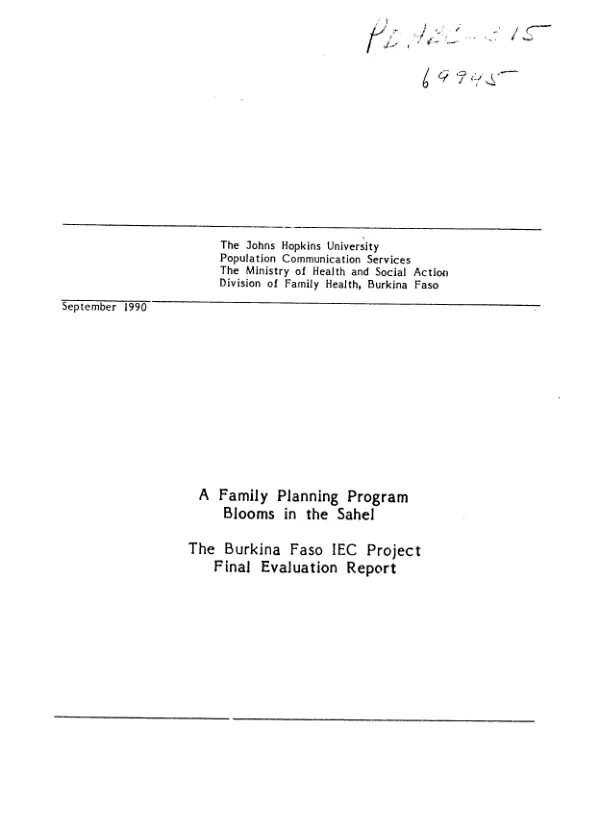
Family planning program blooms in the Sahel : the Burkina Faso IEC project final evaluation report
Sign inJOHNS HOPKINS UNIVERSITY. CENTER FOR COMMUNICATION PROGRAMS. POPULATION INFORMATION PROGRAM
Family planning program blooms in the Sahel : the Burkina Faso IEC project final evaluation report
Evaluates an information, education, and communication (IEC) project in Burkina Faso.
Bashin, Michelle|Kone, Hugues · 1990
Sign in to readA free account is required to download.
Abstract
Using both quantitative and qualitative measures, the evaluation team gauged knowledge, attitudes, and behavioral changes at the conclusion of this three-year project. The Johns Hopkins University/Population Communication Services (JHU/PCS) and The Ministry of Health and Social Action (MOHSA) launched this $257,077 IEC program in 1987. The project's overall goal was to expand the demand for family planning (FP) services. Evaluation data affirmed that the project's IEC activities had a sizable impact on increasing women's demand for FP services and significantly heightened public awareness of FP. Several key indicators of project impact are detailed below. Behavioral Changes: (1) The total number of FP clients at eight Ouagadougou clinics tripled between 1/88 and 12/89; new clients doubled. (2) Women's use of modern contraceptive methods at these clinics jumped from 8% to 14%, during this same period. Knowledge Changes: 92% of survey respondents correctly identified at least one provider of FP services, well above the 40% initially targeted by the project; 89% of these respondents recalled having seen the national FP logo; and 63% correctly associated the logo with FP. Attitudinal Changes: The proportion of women desiring FP services at the eight clinics more than doubled (6.1% to 12.9%) between 1/88 and 12/89. Exposure to Project Interventions: (1) 77% of adults surveyed had attended at least one discussion on FP. (2) 75% recalled having seen the national FP logo at maternal child health centers, clinics, or dispensaries, 57% recalled seeing the FP logo on billboards and 48% on posters. (3) 93% of those who had seen the project's theater forum performance correctly recalled its FP themes 18 months later. Cost Recovery: 85% of production costs for 6,588 meters of printed cloth with the FP logo were recovered through sales. In the course of this three-year project, the Division of Family Health expanded its capacity to develop quality IEC materials and conduct effective FP/IEC training of outreach workers. The project produced FP promotional materials impressive in quality, variety, and number. The MOHSA developed a rigorous FP communication curriculum and with it trained 140 outreach workers. Both the clinic and the impact surveys demonstrate that the Burkina Faso IEC Project went beyond raising popular awareness of FP, and contributed to changing contraceptive behavior. This change is reflected in an increased demand for FP services, growth in the numbers of clinic clients, and increases in contraceptive use. The growing acceptance of FP in Burkina Faso demonstrates the potential of a carefully conceived, well-implemented IEC strategy to generate demand for FP. (Author abstract)
Related documents
Documents in this collection
USAID DEC
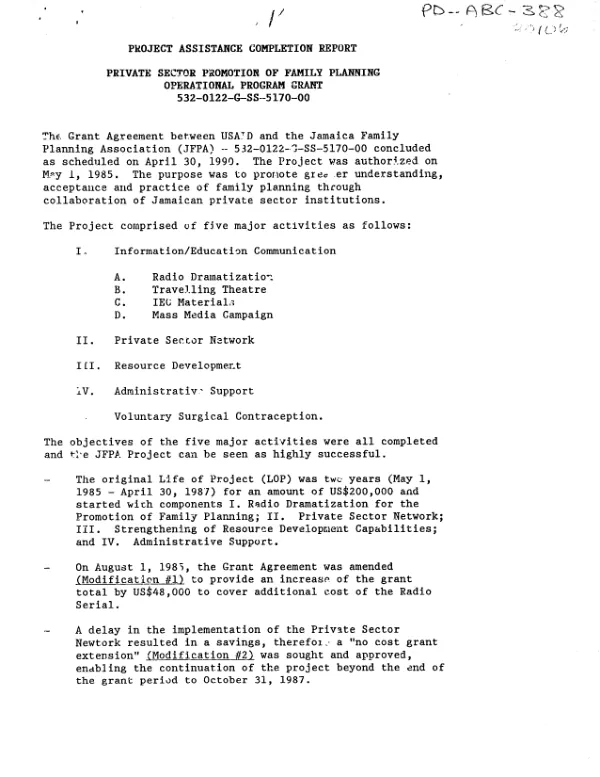
Project assistance completion report : private sector promotion of family planning -- operational program grant 532-0122-G-SS-5170-00
Open record 1992
1992USAID DEC