USAID DEC
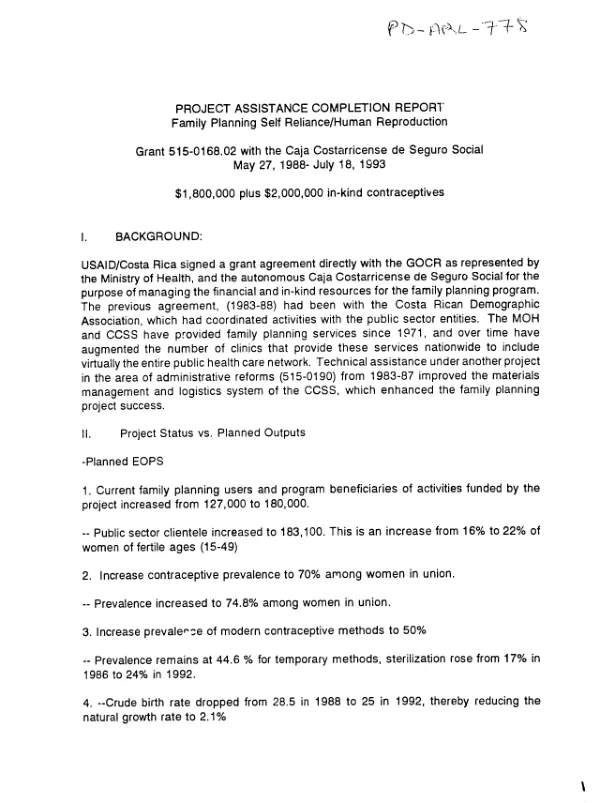
Project assistance completion report : family planning self reliance/human reproduction -- grant 515-0168.02 with Caja Costarricense de Seguro Social, May 27, 1988-July 18, 1993
Sign inUSAID. MISSION TO COSTA RICA
Project assistance completion report : family planning self reliance/human reproduction -- grant 515-0168.02 with Caja Costarricense de Seguro Social, May 27, 1988-July 18, 1993
PACR of a subproject (5/88-7/93) to strengthen family planning (FP) service provision by the Costa Rican Social Security Fund (CCSS).
1992
Sign in to readA free account is required to download.
Abstract
The project surpassed most of its targets. Public sector clientele increased from 127,000 to 183,000 vs. a target of 180,000, while contraceptive prevalence among women in union increased to 74.8% vs. a goal of 70%. Modern contraceptive methods remain at 44.6% for temporary methods vs. a goal of 50%, but sterilization rose from 17% in 1986 to 24% in 1992. Finally, the crude birth rate dropped from 28.5 in 1988 to 25 in 1992, thereby reducing the natural growth rate to 2.1%. Specific achievements were as follows. (1) CDSS is now procuring of its requirements for oral contraceptives, condoms, and IUDs, and the method mix was expanded in 1993 to include Depo-Provera. Sterilization remains tightly controlled and must be justified before a medical board. (2) Training emphasized training of trainers, in-service clinical training, and inclusion of practical clinical and counseling aspects in medical and nursing school academic and internship programs; a core group of medical doctors and nurses received technical training at the Johns Hopkins Program in Obstetrics and Gynecology and have subsequently prepared curricula for their universities and teaching centers. (3) Nationwide contraceptive prevalence surveys were carried out and preliminary results were published; continued analysis will be financed under project 5150261. Patient flow analysis in clinics pointed out strengths and weaknesses in outpatient management. (4) Mass media, print, nd video information, education, and communication (IEC) materials were developed for a variety of groups, including industrial workers, adolescents and pre-adolescents, and postpartum women. (5) Although the project management unit has dissolved, the CCSS has approved a new position to monitor reproductive health concerns within the Women's Health Program. Training, logistics, procurement, and information programs all continue. Lessons learned include the following. (1) The success of Costa Rica's FP programs may not be replicable because of the unique strength of the country's public health programs. Statistics show demand is greater in the public, prepaid sector than in the significantly higher-cost private sector market. No major NGO is involved in clinical services. The subproject helped the CCSS to improve access to and quality of services. (2) Rural residence, socioeconomic status, and, above all, female education are still major indicators of differences in fertility. (3) In a country with a strong health services network and a mature FP program, transition to full domestic financing is highly desirable. By subproject end, the program had been institutionalized as part of Costa Rica's preventive health scheme, with provision of outpatient services on a regular basis. The fear that external entities were setting policies had been overcome. (4) Even if services are horizontalized, there needs to be a person monitoring procurement logistics, technical standards, new product introduction, training, and information.
Related documents
Documents in this collection
 1970
1970USAID DEC
Project assistance completion report : family planning self reliance/human reproduction -- grant 515-0168.02 with Caja Costarricense de Seguro Social, May 27, 1988-July 18, 1993
Open record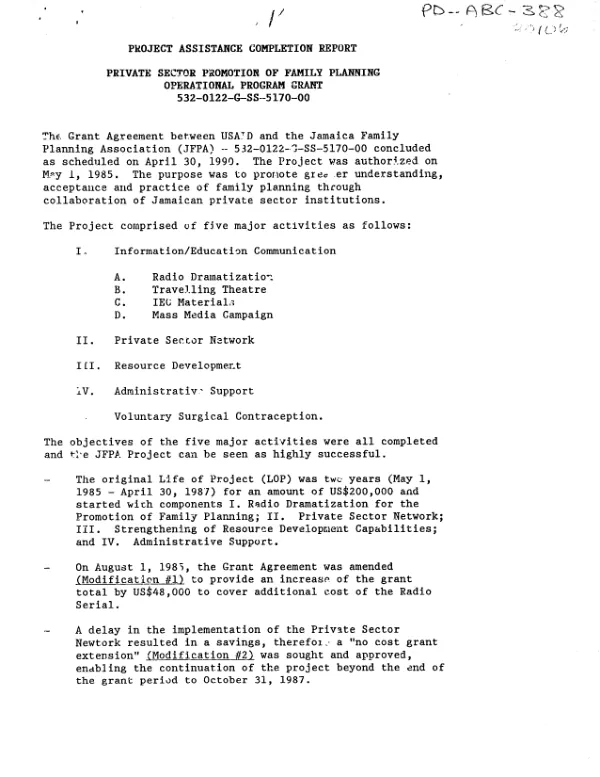
USAID DEC