USAID DEC
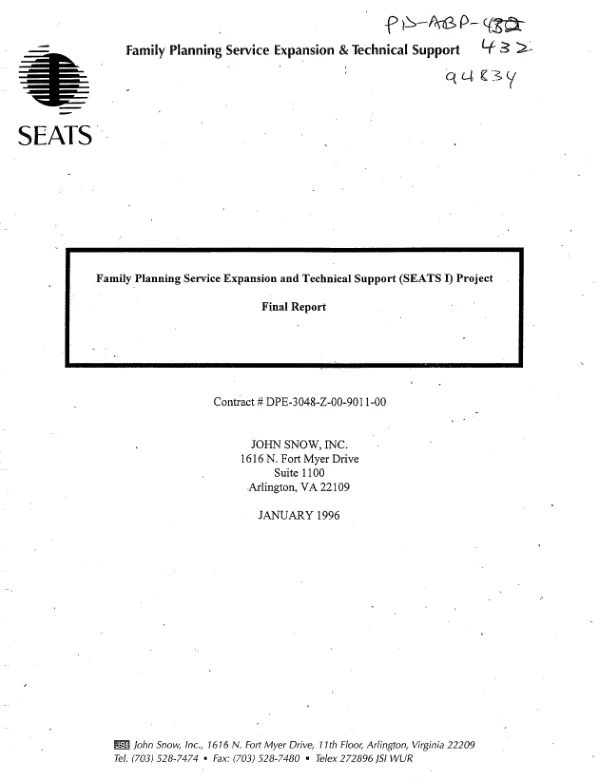
Family planning service expansion and technical support (SEATS I) project : final report
Sign inJOHN SNOW, INC. (JSI)
Family planning service expansion and technical support (SEATS I) project : final report
Final report of the contractor, John Snow, Inc., on a project (7/89-12/95) to expand the use of quality family planning (FP) services in underserved populations (SEATS I project).
1996
Sign in to readA free account is required to download.
Abstract
SEATS I, which worked in 23 countries of sub-Saharan Africa, Asia, the Near East, and the South Pacific, met or surpassed all contract objectives. In a departure from past FP initiatives, SEATS I focused on developing national FP programs as opposed to unrelated subprojects. In each project country, SEATS I helped to establish a unique national FP program comprised of subprojects, innovative technical and programmatic initiatives, and intensive and interdisciplinary TA to improve service delivery and also institutional capacities toward the goal of increased sustainability. Above all, the project"s approach -- characterized by strategic analysis and planning, flexible design and resource allocation, collaboration with other agencies, and decentralized decisionmaking -- distinguished SEATS I from other projects and greatly contributed to its achievements. SEATS I generated 1.5 million couple years of protection (CYP), almost 50% more than the contract deliverable. Forty-three subprojects in 14 countries provided services at 1,460 sites. More than 80 training sessions were conducted in subjects as varied as clinic management; long-term and permanent contraception; information, education, and communication (IEC); community-based distribution; and continuous quality improvement. SEATS I also produced 8 training manuals, developed a project-wide management information system, and procured more than $4.2 million worth of equipment for subproject partners. None of this would have been possible without the intensive, directed, and timely TA provided by 16 resident advisors (RAs) and a multi-disciplinary team of professional experts. SEATS I subprojects demonstrated the viability of a variety of service delivery mechanisms in countries where FP services had been limited to clinic-based sites. These mechanisms included community-based distribution (CBD), workplace-based services, peer counseling, and incorporation of FP into existing networks, such as mission health services and social security systems. In several countries, SEATS I placed RAs to strengthen institutional capacity for strategic planning and management of national programs. In other countries, RAs played a "bridging" role, supporting activities while bilateral programs were being developed. Encompassing all of the project"s service delivery efforts was a commitment to introducing and maintaining technical innovations. The project introduced long-term and permanent FP methods widely, traditionally a strategy mainly for mature FP programs. The lactational amenorrhea method (LAM) was also advanced in several countries. Taking a grassroots approach to quality of care, SEATS I developed and introduced a clinic-based method of continuous quality assurance that enables staff to identify problems and design low-cost solutions. SEATS I was one of the first cooperating agencies (CA) to have a Women"s Health Advisor to help incorporate reproductive health issues into FP programs. The project developed two manuals on cost-recovery and user fees for FP program managers. A multi-country study on urban FP resulted in strategies to expand services in rapidly growing cities. SEATS I also was a vocal supporter of including FP and reproductive health services as part of basic health services in refugee situations. The project"s flexible strategic approach allowed it to support activities in countries undergoing civil strife, incorporate new initiatives into country program, and respond rapidly to the new USAID Priority Country Strategy, shifting resources to programs in two priority countries -- Morocco and Turkey -- and solidifying its involvement in FP activities in other priority countries. The decentralization of technical, administrative, and financial functions through two regional offices in Togo and Zimbabwe allowed the project to meet country needs in a timely and appropriate manner. Collaboration with at least eight other USAID CAs at the field level facilitated efficient and selective deployment of resources. Lessons learned are as follows. (1) A broad mandate is important to provide effective assistance in the establishment of national FP programs. (2) Substantial amounts of direct TA can lead to the creation of national programs. (3) Strategic analysis and planning is needed to make best use of resources. (4) Flexibility in project design and operation allows rapid and effective responses to changes. (5) Decentralization of decision making to the regional and local levels facilitates appropriate allocation of resources. (6) Collaboration maximizes program inputs. (Author abstract, modified)