CARE INTERNATIONAL
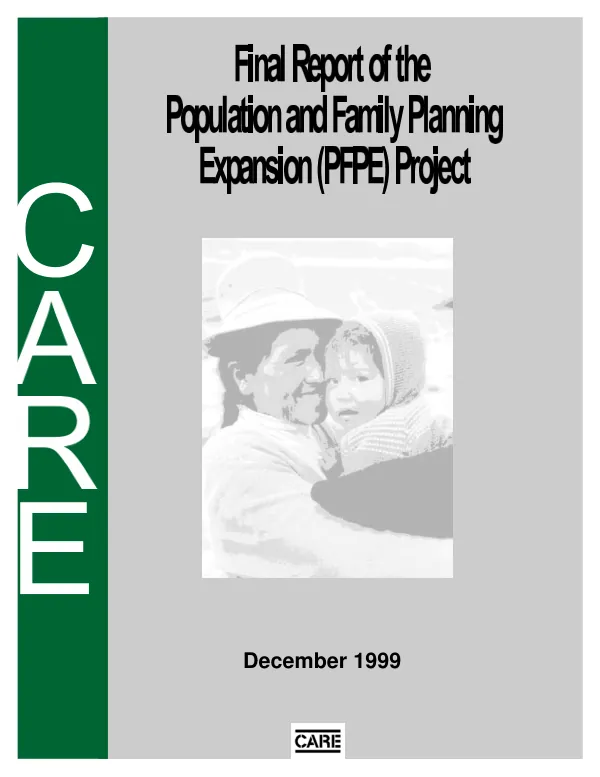
Final report of the population and family planning expansion (PFPE) project
Final report of the contractor, CARE, on the Population and Family Planning Expansion (PFPE) project (1991-99), designed to: (1) develop CARE"s capacity to design and implement FP programs; (2) establish new models of FP service delivery that draw upon CARE"s work in other sectors; and (3) increase access to FP information and services, especially in hard-to-reach areas.
1999
Sign in to readA free account is required to download.
Abstract
All PFPE objectives and projected outputs have been exceeded, as documented through the PFPE annual reports, the final project evaluation (PD-ABL-349), an extensive case study of CARE"s FP and reproductive health (RH) experience (PN-ACF-111), and USAID annual management reviews. Major accomplishments include the following: all 38 CARE country offices have addressed FP/RH issues in multi-year plans; 1.1 million new and 4 million continuing users have been reached with information or services, generating nearly 3.5 million couple-years of protection (these figures exceed original PFPE expectations); CARE now has a portfolio of 59 FP/RH projects in 32 countries and a committed core of FP/RH professionals; and an FP/RH framework has been integrated into CARE"s broader development approach. The impact of these achievements has been notable. CARE"s RH portfolio, which was virtually non-existent in 1991, now includes 36 projects with a major FP focus, of which 31 have a clinical component, 27 a community-based distribution component, 23 a post-partum emphasis, and 9 a commercial component. CARE also has 33 maternal health projects and 42 sexually transmitted disease (STD)/HIV projects. Most projects are integrated, with multiple RH elements, so the project numbers are not mutually exclusive. The projects cover the range of functional areas: 38 address institutional capacity-building, 33 have a community empowerment component, and 30 focus on quality of care. The projects also cover a range of target audiences, including 37 country programs with a dedicated male involvement component, 32 focusing on adolescents, and 2 country programs providing RH for refugees. The latter is an excellent example of the multiplier effect of the PFPE grant. No Office of Population funds have gone into the refugee programs. RH is now an integral part of CARE"s refugee programming at no direct cost to the Office of Population. Before PFPE, CARE staff rarely, if ever, participated in professional meetings on RH, let alone contributed original intellectual products. That situation has changed dramatically. CARE staff now participate in professional conferences, and have produced many papers and presentations on FP and RH, often in collaboration with other organizations and USAID projects, including the Population Council, Georgetown University, and the FOCUS Project. Special emphasis has been placed on developing and disseminating tools using participatory approaches. These include the CARE Mid-Term Evaluation Guidelines, which rely heavily on stakeholder evaluation. CARE, in partnership with FOCUS, has published a manual entitled "Listening to Young Voices: Facilitating Participatory Appraisals on Reproductive Health with Adolescents" and will soon release "Embracing Participation in Development: Worldwide Experience from CARE"s Reproductive Health Programs with a Step-by-Step Field Guide to Participatory Tools and Techniques." CARE staff have also produced technical manuals that have gained wide usage and recognition in the RH community, including "Promoting Quality Maternal and Newborn Care and Reproductive Health Programming Refugee Settings." The success of the CARE program has encouraged other PVOs to enhance their RH programs and has led the Office of Population to support a major program of collaboration with PVOs, including Save the Children, Plan, and ADRA. CARE"s PFPE experience provided valuable programmatic experience for other NGOs in establishing FP and RH activities. Key areas of experience, detailed in the final report, cover: (1) NGO models for FP service delivery; (2) benefits of building on other development activities; (3) partnerships; (4) PVO advocacy efforts for RH; and (5) community empowerment and local ownership of RH services.