USAID. MISSION TO TANZANIA
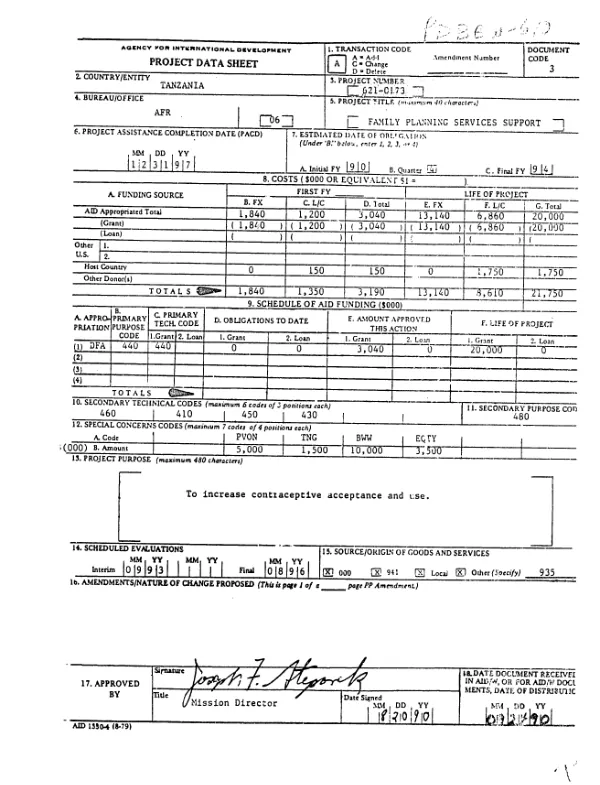
Family planning services support
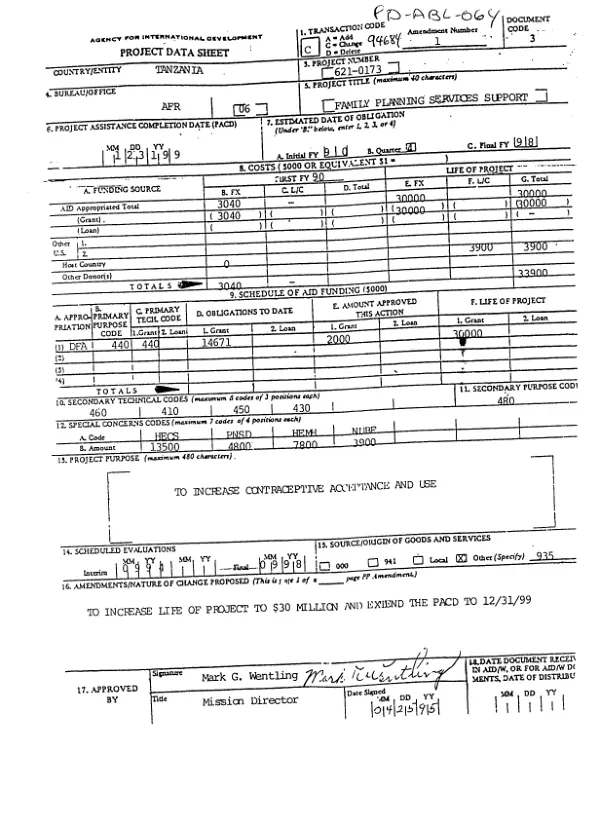
Project to increase contraceptive acceptance and use in Tanzania.
1990
Sign in to readA free account is required to download.
Abstract
The project will: (1) expand the delivery of clinical family planning (FP) services; (2) strengthen the institutional capacity of the Ministry of Health (MOH) and the Family Planning Association of Tanzania (UMATI); and (3) develop FP management information systems (MIS). Using contraceptives supplied by the UN Population Fund, USAID/T, and the International Planned Parenthood Federation, the project will meet 40%-50% of Tanzania"s contraceptive requirements. The supplies provided by the various donors will be developed into contraceptive kits and distributed using the existing channels of the Expanded Program of Immunization and the Essential Drug Program; warehousing for contraceptive and pharmaceutical supplies will be expanded as well. To further improve FP service delivery, the project will support pre-service training at maternal/child health aide and nursing institutions, help revise the medical curriculum at Muhimbili Medical Center, upgrade the FP training programs of the MOH and UMATI, and sponsor training courses for supervisors of FP clinics. The project will also: (1) expand the use of alternative contraceptive methods by adding additional sites for surgical contraception and by training doctor-nurse teams in IUD provision; and (2) support the incorporation of FP services at clinics run by private and parastatal companies. The project will strengthen both the MOH and UMATI. For a new MOH FP Unit which will be responsible for overall project management, the project will finance support staff, office space and equipment, and management and technical training. The project will help UMATI undertake a planning exercise to determine its staffing and resource needs under the project, and will fund these accordingly. Finally, Johns Hopkins University"s Population Communications Services will help both UMATI and the MOH develop information, education, and communication (IEC) activities. Finally, the project will develop MIS for use in FP program development and management. Efforts will include (1) two national Demographic and Health Surveys to provide baseline and follow-up data on contraceptive prevalence and awareness of FP; and (2) a national FP management information system, including service delivery information, clinic inventories, and a sentinel reporting system on contraceptive distribution. Operations research activities will also be supported. Amendment of 4/95 increases funding by 50% and extends the PACD to 12/21/99. (1) Under the service delivery component, the project will continue to support the decentralization of FP training in up to 10 regions as well as the provision of training (including training in AIDS/sexually transmitted disease prevention and counseling), with the aim of providing over 70% of hospitals and 50% of health centers and dispensaries with at least one trained service provider by the PACD. This component will also support an extensive array of related IEC efforts, the provision of quality long-term and permanent FP methods to 112 sites (half of them in the private sector), community-based contraceptive distribution (CBD) programs by NGOs, and development of a logistics management information system. (2) The institution-building component will strengthen the capacities of the MOH"s Family Planning Unit (FPU) to implement the National Family Planning Programme (NFPP) by assisting the FPU in the areas of service delivery, FP training, logistics, CBD service expansion, FP policy development, and program management. It will also help the FPU to develop an action plan to track its progress in fulfilling project covenants, develop options for achieving financial and technical sustainability, and improve the integration of FPU-supported NGO and private sector activities into the NFPP"s overall strategy. The project will conduct a separate assessment of social marketing potential for FY 96, and, given the success of the Salama condom marketed through the Tanzania AIDS Project, explore the possibility of marketing an oral contraceptive or other FP commodity in selected areas. (3) The third component will: undertake a second demographic and health survey in 1996, and a national knowledge, attitudes, and practices (KAP) survey in 1998; refine the FPU"s information systems, establishing a logistics management information system (LMIS) and providing TA needed for its use; and undertake operations research in the areas of male involvement in FP, quality of care, approaches to service delivery, and IEC. Special studies will analyze which market segments have been reached, identify causes of contraceptive discontinuation, and identify reasons for the project"s success. (PD-ABL-064)
Related documents