USAID
FARA Deliverable Verification: Year 4, Q3-4
The Fixed Amount Reimbursement Agreement (FARA) verification exercise was conducted in six counties in Liberia, including Bong, Lofa, Nimba, Grand Cape Mount, Grand Gedeh, and River Gee.
2021 · 106 pages
Sign in to readA free account is required to download.
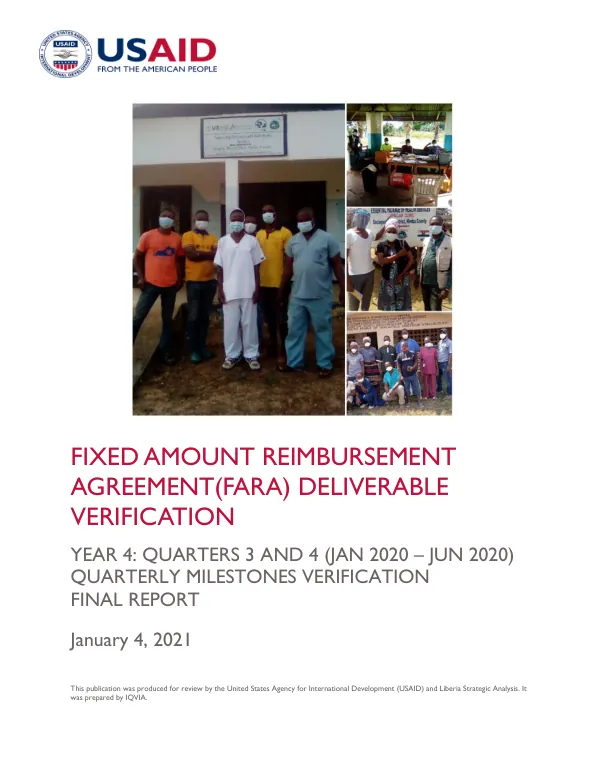
Abstract
The verification aimed to collect data on 16 milestones under the quarterly verification category for Year 4, Quarter 3 (January to March 2020) and Quarter 4 (April to June 2020). The exercise was carried out by IQVIA, a local partner, Community Health Education and Social Services (CHESS), and a team of data collectors and supervisors. The verification process involved a two-day virtual training of trainer workshop for the research team lead and data quality manager, followed by a three-day classroom training program for all data collectors and supervisors. The training equipped the team with knowledge and skills to execute the project effectively. The data collection tool on SurveyCTO was created for each of the questionnaires, and the data collectors and supervisors were assigned brand new smartphones for data collection. Field data collection was conducted from November 16 to November 27, 2020, with 18 teams and nine supervisors deployed in five counties. The data collectors recorded data manually on a hard copy of the questionnaire, and the supervisor reviewed the data before submitting it to the SurveyCTO application. The data underwent a first level of quality check by the supervisor, followed by a second level of quality check by the data quality manager and assistant data quality manager, and a third level of quality check by the central quality control team. The results of the verification exercise are summarized below. In Quarter 3, the percentage of sampled facilities assessed to have implemented at least 80% of planned activities in the updated business plan ranged from 33% in Grand Cape Mount to 59% in Bong. The percentage of health facilities submitting timely and complete data in the Logistics Management Information System (LMIS) ranged from 2% for ARV and Test Kits in Bong to 60% for Essential Medicines in River Gee. The percentage of health facilities that held at least three Health Facility Development Committee (HFDC) meetings per quarter with all conditions fulfilled ranged from 10% in Lofa to 48% in Bong. The percentage of maternal deaths reported with reviews conducted and actions taken ranged from 0% in Grand Cape Mount to 100% in Nimba. The percentage of neonatal deaths reported with reviews conducted and actions taken ranged from 25% in Bong to 100% in Nimba. The timely and completeness of County Health Team (CHT) quarterly financial and program reports submitted ranged from 0% in River Gee to 100% in all other counties. The percentage of health facilities with quarterly bonus paid ranged from 0% in River Gee to 100% in all other counties. The results of the verification exercise will help USAID determine the extent to which the Ministry of Health (MOH) is reimbursed for the outputs achieved for each milestone. The exercise will also provide insights into the performance of the health facilities and the effectiveness of the FARA program in achieving its objectives. The verification exercise was conducted in accordance with the guidelines and requirements provided by USAID and Liberia Strategic Analysis (LSA). The exercise was supported by a local partner, CHESS, and a team of data collectors and supervisors. The results of the exercise will be used to inform decision-making and improve the performance of the health facilities and the FARA program. The verification exercise covered a total of 134 health facilities in the six counties, with 50% of the facilities selected in each county for the quarterly verification. The selection of facilities was done based on IQVIA and LSA's understanding of the requirements and guidelines. USAID approved the list of sampled health facilities. The verification exercise was conducted in a timely manner, with field data collection taking place from November 16 to November 27, 2020. The data collection tool on SurveyCTO was created for each of the questionnaires, and the data collectors and supervisors were assigned brand new smartphones for data collection.