USAID. MISSION TO GHANA
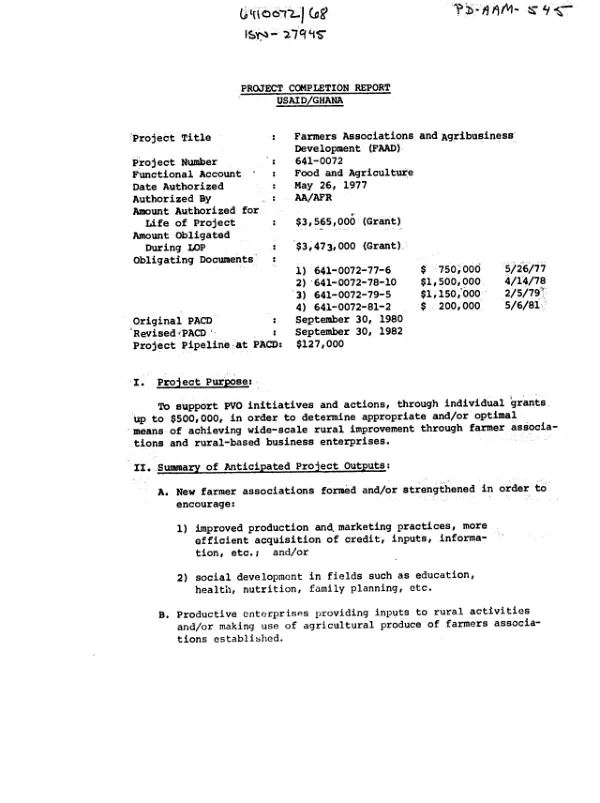
Farmers associations and agribusiness development (FAAD)
Provides final Mission report (1/78-7/82) on a project to support PVO activities aimed at promoting farmer associations and rural-based business enterprises in Ghana.
1983
Sign in to readA free account is required to download.
Abstract
Progress in achieving project objectives was mixed. Two U.S. and five Ghanaian PVO's received grants; funds were used to procure commodities (the Africa Bureau's blanket waiver to procure shelf items from neighboring countries was extensively used because of high Ghanaian prices), provide technical assistance, and sponsor participant training for 41 individual rural development activities. Organizations assisted included bread bakers, beekeepers, fishing associations, poultry producer cooperatives, sugarcane production and processing cooperatives, and weaving and woodcarving enterprises. Some activities had good results on a localized basis while others were dismal failures. All activities met with some degree of failure due to the complete deterioration of the Ghanaian economy. Several deficiencies on the part of the Ghanaian PVO's - their lack of organizational and administrative confidence, their complete dependence on A.I.D. for finances, and their inability to meet A.I.D. registration requirements - further hampered implementation and consumed an unreasonable amount of USAID/G time. All of the PVO's were dismayed at USAID/G's unwillingness to pay overhead for general support costs. USAID/G believes this is a valid complaint if A.I.D. wishes to increase emphasis on involving PVO's in rural development. The project taught that while PVO's can be used to promote rural development, PVO projects tend not to be cost-effective. For future PVO projects, it is recommended that a grant be provided to a single well-established U.S.-based PVO which would register eligible indigenous PVO's and assist them in writing proposals and documenting and implementing grants. It is recommended that the USAID/G continue to loosely monitor PVO activities to observe the sustained viability of farmer associations and rural enterprises assisted; that an End of Project evaluation not be conducted; and that a follow-on project not be considered because of continued macro-economic constraints in Ghana.