USAID. MISSION TO GHANA
Village development through non-formal education
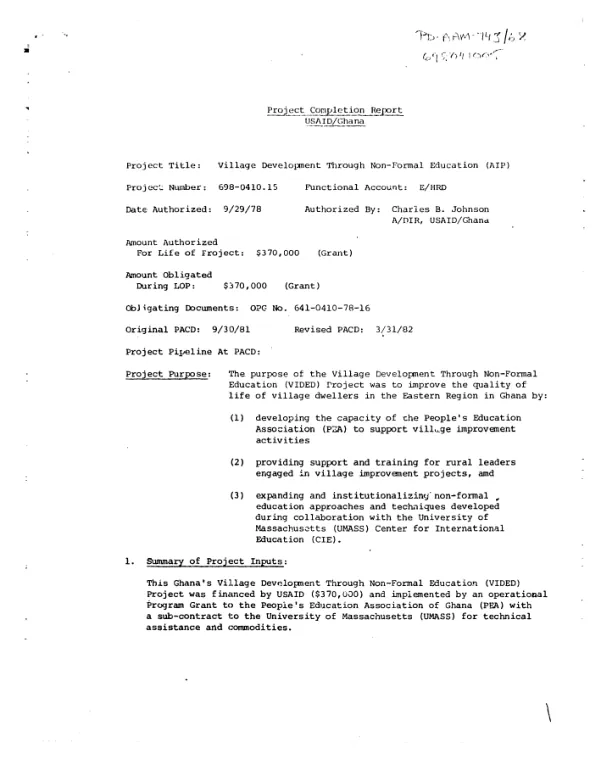
Provides final Mission report (9/78-3/82) on a project to develop the capacity of the People"s Education Association of Ghana (PEA) to support village improvement activities and expand nonformal education in Ghana"s Eastern Region.
1983
Sign in to readA free account is required to download.
Abstract
The project achieved its objectives. Village life was improved through provision of piped water and establishment of a rural health clinic in one village, construction of a school block in a second village, road improvement in a third, increased availability of soap in the region, and the construction and sale of water-sealed toilets. Six Ghanaians were trained to design and implement rural development projects and respond to community initiatives. Technical assistance (i.e., the services of an administrative advisor for one year and a trainer for two years) was provided to PEA by the University of Massachusetts. The project also contributed to PEA"s visibility, to its popularity among community leaders and local officials, and to a more competitive environment for government to work in. The promotion of physical and income-generating projects in addition to PEA"s usual adult education and literacy activities has made PEA (Eastern Region) an example for other PEA groups of what can be accomplished at the local level with minimal assistance. The main constraints on the project were inadequate staffing (due to turnover and late recruitment) and the loss of volunteer community facilitators, many of whom were teachers who departed Ghana for employment in neighboring countries. Implementation was also hindered by incomplete documentation and PEA"s inexperience in operating within A.I.D. restrictions. Nevertheless, PEA"s overall implementation performance was better than satisfactory. It is recommended that the Mission maintain passive contact with PEA to demonstrate its continuing interest.
Related documents