USAID. MISSION TO PHILIPPINES
Farming systems development project - Eastern Visayas
Summarizes mid-term evaluation (XD-ABA-841-A) of a project to strengthen farming systems research and extension (FSR/E) entities in the Eastern Visayas region of the Philippines.
1990
Sign in to readA free account is required to download.
Abstract
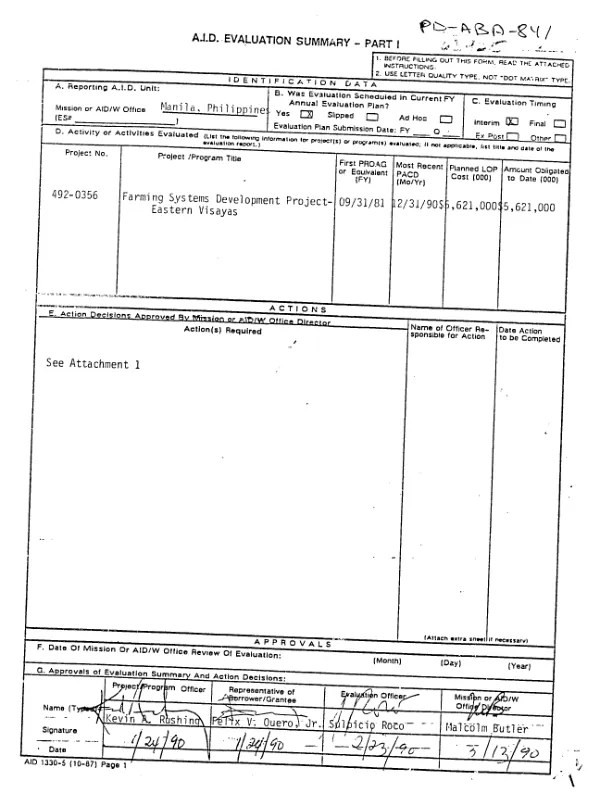
The evaluation covered the period 9/81-1/90. The project has clearly demonstrated that extension workers and farmers can successfully conduct on-farm research. Major project accomplishments include the following. (1) Six research management units have been established. (2) The Visayas State College of Agriculture (ViSCA) created the Farm Resources Management Institute (FARMI) as a center for FSR/E back-up research, and the program is now being integrated into the regional Department of Agriculture (DA). (3) To date, the DA has conducted 111 FSR/E projects while ViSCA has conducted 52. (4) More than 10 farming technologies have been adapted and disseminated for hilly upland areas. (5) Some 1,655 farmers and professionals have received training. (6) The farmer-to-farmer extension method is well accepted, and has assisted 1,614 farmers in adopting new farming technologies. A major problem is that the DA"s extension and research units have different perceptions of FSR/E. Linkages between the DA and ViSCA should be strengthened through interactive management work. The project"s workplans and field management also need to be improved. Several lessons were learned. (1) The FSR/E approach needs continuous nurturing to be fully institutionalized. (2) Farmers will accept technology when they participate in its application, and when they are trained by other farmers. (3) Hilly upland research/extension is difficult, slow, and eludes vigorous cost- benefit analyses. (4) Decentralization creates the need for new initiatives on the part of all, particularly DA leaders and program managers.
Related documents