USAID. BUR. FOR LATIN AMERICA AND THE CARIBBEAN. REGIONAL DEVELOPMENT OFC.
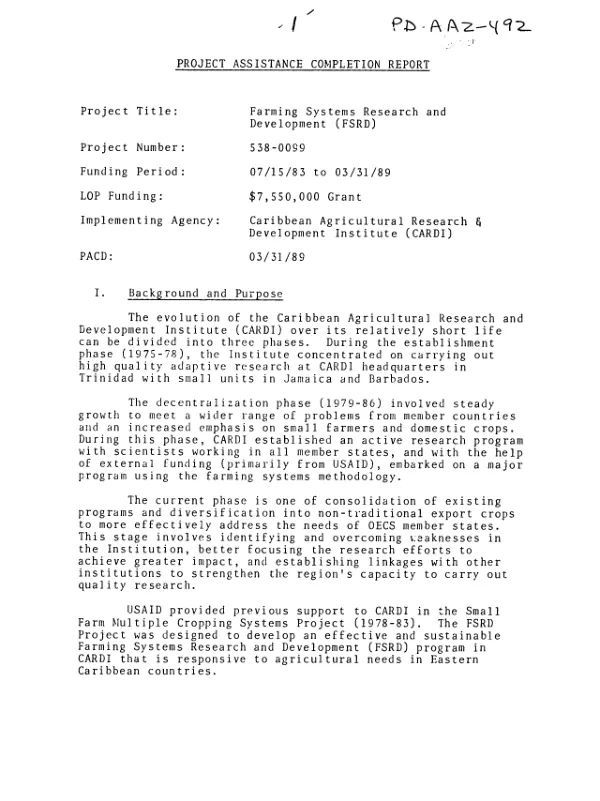
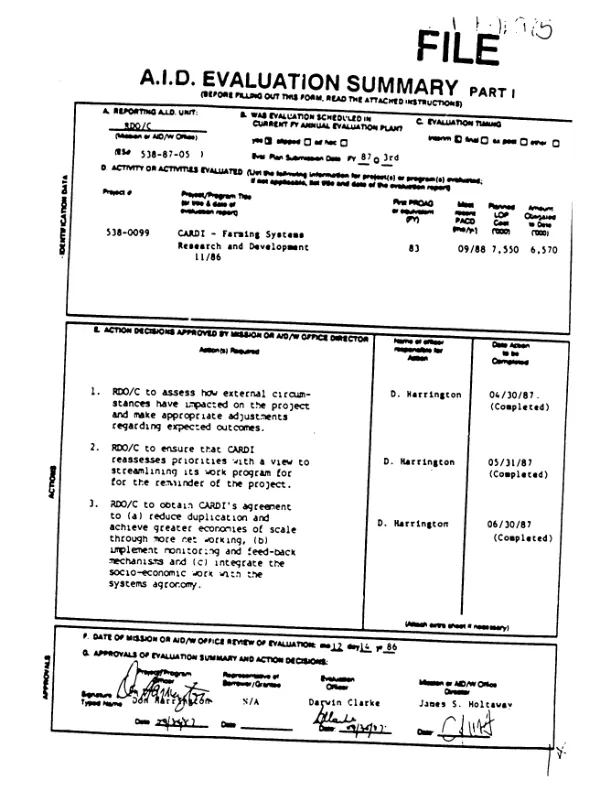
CARDI - farming systems research and development (11/86)
Evaluates project to assist the Caribbean Agricultural Research and Development Institute (CARDI) to develop a farming systems research and development (FSR/D) program in the Eastern Caribbean.
1987
Sign in to readA free account is required to download.
Abstract
Interim evaluation covers 1978-9/87 and is based on document review, site visits, and interviews with project personnel. The project has made significant progress towards achieving its objectives in spite of delays and institutional weaknesses. Intrinsic to the project"s problems is a project design that was too ambitious and unrealistic, especially with regard to time frame, the availability of host government counterparts and financial support, and project sustainability. Also, the "bottom-up" style of FSR/D has proven very slow in an environment used to a "top-down" style. Finally, the amount of development effort (as distinct from pure research) needed to test and validate the technologies was underestimated. The research staff has a very limited capacity to respond to such developmental demands on which the success of research ultimately hinges. The FSR/D methodology seems valid for the Caribbean. It is being slowly refined and many features of it offer considerable hope for the future. Foremost among these are the participatory style of research; on-farm testing to assure adaptability of new technologies; the joint consideration of research and marketing; and the use of pre-research studies in which farm conditions influence research design. However, not enough thought has been given to the identification of target groups; the FSR method needs to be tested under a wider variety of Caribbean farming systems; and simplification of the multi-step method needs to be considered. A good deal of technology is being developed by CARDI, but not all is relevant to the participating countries. In a few cases, the results of technology development have been validated on-farm and are being adapted by farmers, but in general the project"s impact is being limited by the minimal capacity of the extension services to transfer the new technologies. On the positive side, the Technological Improvement File (TIF) as a dynamic repository of research information is an excellent idea; some 42 TIF"s are or have been developed. The project demonstrates that: (1) for an adaptive agricultural research project to be successful, an effective extension service is needed; and (2) a project design should be flexible to allow for changes in the research methodology in order to accommodate shifting emphases in crops, research thrusts, and target groups. It is recommended that A.I.D. continue to support a research network in the Eastern Caribbean; pursue with other donors the objectives of a restructured CARDI; search for a better link with extension services; and immediately reassess CARDI"s priorities.