USAID DEC
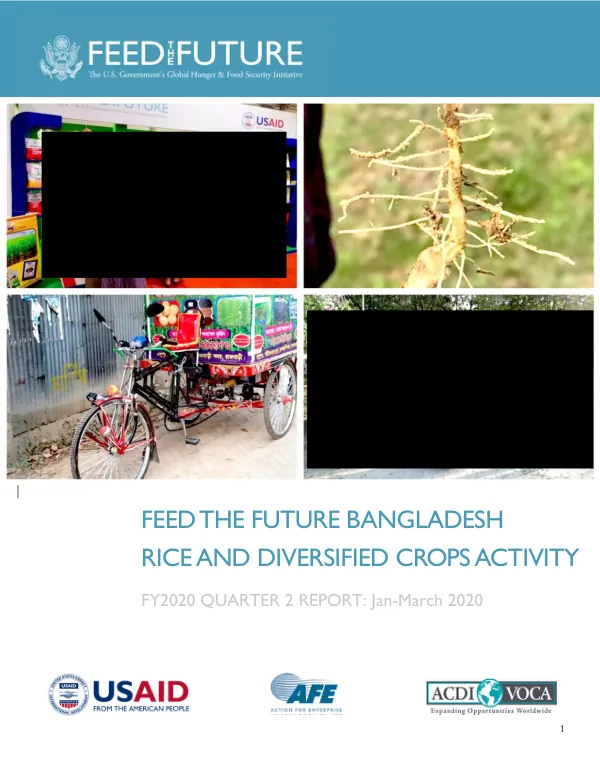
Feed the Future Bangladesh Rice and Diversified Crops (RDC) Activity FY2020 Quarter 2 Report
Sign inACDI/VOCA
Feed the Future Bangladesh Rice and Diversified Crops (RDC) Activity FY2020 Quarter 2 Report
The United States Agency for International Development (USAID) Feed the Future (FTF) Bangladesh Rice and Diversified Crops Activity (RDC) aims to catalyze changes in market systems that promote intensified rice production and diversification of cropping systems into higher-value nutrient-rich crops in the FTF zone.
2020 · 19 pages
Sign in to readA free account is required to download.
Abstract
The activity focuses on seven sectors: rice, maize, groundnut, mung-bean, lentil, sunflower, and sesame, as well as cross-cutting crop protection/fertilizer, mechanization, and financial services. RDC plans to support firms to provide access to new technologies and improved management practices for smallholder producers through improved availability of seed (and seed treatments), seedlings, fertilizer (including inoculants), crop protection products, procurement mechanisms, mechanization, information and communications technology (ICT), and access to finance. The activity targets a total access outreach of 277,634, including 9% female and 6% youth participation. During the second quarter of fiscal year (FY) 2020, RDC signed 24 Fixed Amount Sub-Awards (FAS) with companies, eight of which will allow companies to scale-up and expand activities proven to be successful through previously completed agreements. These agreements are expected to support 230,000 farmers in obtaining access to new technologies and lucrative markets. As of the reporting quarter, an estimated 129,116 farmers had already received quality inputs, access to markets, mechanization services, and financial and information support. The activity has achieved several milestones, including the supply of 409.89 MT improved seed varieties, procurement of 82 MT mustard and 5 MT groundnuts through new marketing channels, and marketing of 0.78 MT inoculant and 75 MT of micronutrients for pulse crops. Mechanization intervention has resulted in the sale of 23 machines, including 21 combine harvesters and 2 rice transplanters, and 12,600 producers have received mechanization services through the hiring of planting and harvesting services provided by local service providers (LSPs). Additionally, 245 producers have opened bank accounts through 55 micro-merchants, and 111 of those producers have received agri-loans valuing around US$ 26,190. The activity has also facilitated the establishment of agent banks in financially underserved areas of the FTF zone, with nearly 2000 customers now receiving formal banking services, including SME/agri-financing, payment services for utilities, savings/deposit schemes, and remittance services. Point of Sales (POS) technology has been installed at 14 dealers, improving the efficiency of their agricultural input retailing businesses.