USAID DEC
Feed the Future Bangladesh Rice and Diversified Crops (RDC) Activity FY2018 Quarter 1 Report January 15, 2018
Sign inACDI/VOCA
Feed the Future Bangladesh Rice and Diversified Crops (RDC) Activity FY2018 Quarter 1 Report January 15, 2018
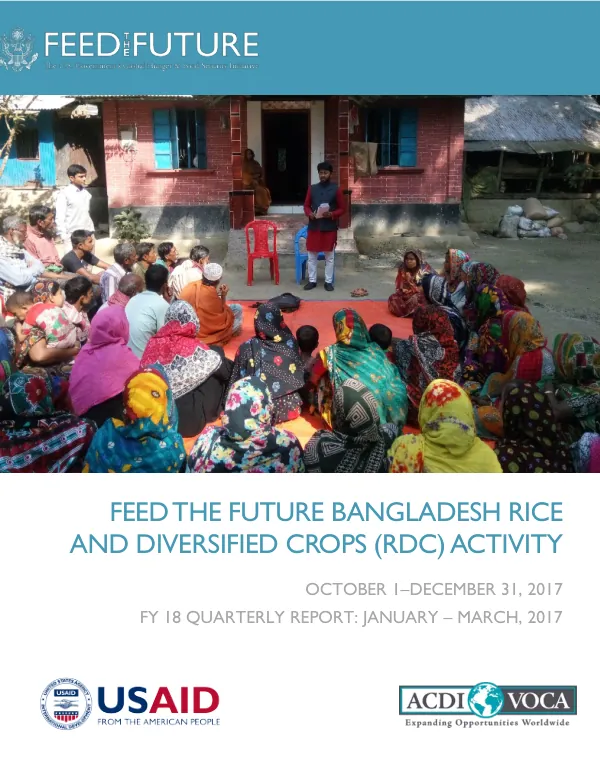
The USAID Feed the Future (FTF) Bangladesh Rice and Diversified Crops Activity (RDC) aims to catalyze changes in market systems that promote a diversified farm management approach oriented to intensified rice production and diversification of cropping systems into higher-value nutrient-rich crops in the FTF zone.
2018 · 10 pages
Sign in to readA free account is required to download.
Abstract
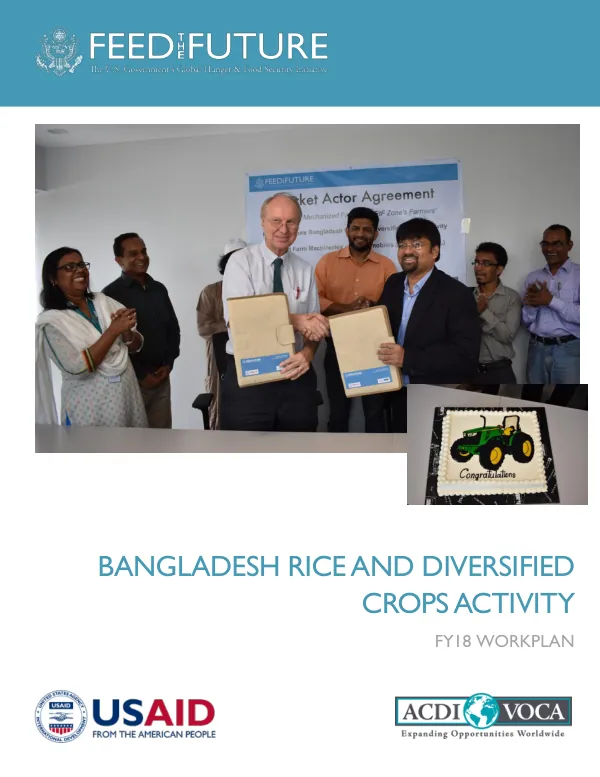
The initiative targets 500,000 farmers from the FTF zone in southwestern Bangladesh and has a budget of US$24.5 million. The project started in July 2016 and will end in July 2021. During the second quarter of FY2018, from January 1 to March 31, 2018, the RDC facilitated inclusive business models with lead firms. Northern Consumer Products Limited (NCPL) procured crops from 750 farmers, including 28% females, who planted 104 hectares of sunflower in Patuakhali and Barguna districts. NCPL trained technicians, field officers, and a field coordinator in sunflower production. The company linked with two seed companies, BRAC Seeds and ACI Limited, to stock their dealers with seed and reserve it for NCPL farmers. Just Farming linked 901 farmers, including 21% females, to plant 450 hectares of mung bean in Patuakhali District for sale to dhal processors. Just Farming trained farmers and staff members in mung bean production. The company linked with a power tiller operated seeder (PTOS) local service provider (LSP) through the USAID Cereal Systems Initiative for South Asia – Mechanization and Irrigation (CSISA-MI) project, resulting in the planting of 8 hectares of machine-planted and line-sown mung bean. SACO linked 600 farmers, including 26% females, to plant 332 hectares of mung bean for processing in the SACO dhal mill in Barguna District. SACO trained farmers and staff members in mung bean production. The USAID Agricultural Extension Support Activity (AESA) helped link SACO to mung bean production groups formed by the Department of Agricultural Extension (DAE), providing a market for these groups of trained farmers. PCF Feed Industries linked 210 farmers, including 15% females, to plant 57 hectares of maize in Bagerhat and Pirojpur districts. PCF Feed Industries trained farmers and staff members and linked with the USAID Livestock Productivity and Improved Nutrition (LPIN) project and a Solidaridad project supported by the Netherlands for markets for their new cattle feed product made with maize procured from RDC-supported farmers. Jadid Grain Industries Limited signed a market actor agreement (MAA) with the aim of forming 10 groups, including 400 farmers, to plant 53 hectares of sesame in Rajbari and Faridpur districts for export. They will train farmers and staff members and procure 500 metric tons of sesame from 800 farmers through traders. RDC is also developing MAAs with Bombay Sweats and ACI Formulations Limited to buy Chinigura (BRRI dhan34) aromatic rice from farmers. The RDC facilitated the development of inclusive business models with lead firms, resulting in the procurement of crops from farmers and the creation of new markets for their products. The initiative has also linked farmers with new technologies and markets, improving their livelihoods and contributing to the development of the agricultural sector in Bangladesh.