USAID DEC
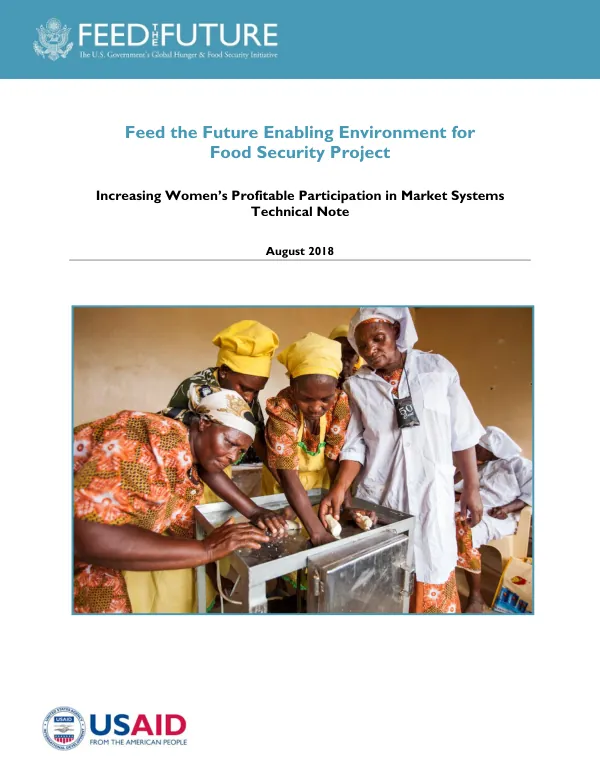
Feed the Future Enabling Environment for Food Security | Increasing Women’s Profitable Participation in Market Systems Technical Note
Sign inFAO
Feed the Future Enabling Environment for Food Security | Increasing Women’s Profitable Participation in Market Systems Technical Note
The focus of this note is on the role of national and institutional policies in creating an enabling environment for an inclusive agricultural sector.
2018 · 20 pages
Sign in to readA free account is required to download.
Abstract
Policymakers are now recognizing the heterogeneity of women in agriculture, moving beyond the traditional view of women as farmers and small-scale traders engaged in producing products or income for home consumption. Current approaches look at women's engagement in farming and trade as a business, with a robust literature documenting the scope, extent, and economic value of work women do in agricultural and food systems. Women agri-entrepreneurs are a key component of an inclusive agricultural sector. Research on women farmers and women traders has revealed both the wide range of available data and gaps in knowledge. New tools, such as the Women's Empowerment in Agriculture Index (WEAI), have been developed to measure women's empowerment in agriculture. The WEAI assesses women's control over and access to resources, including land, credit, and markets, as well as their participation in decision-making and leadership roles. Policies related to labor, property rights, human capacity development, infrastructure, and financial systems can positively or negatively influence the participation and performance of women entrepreneurs and wage workers. For example, policies that strengthen non-discrimination in the workplace or producer associations and cooperatives can improve the participation and performance of both women entrepreneurs and agricultural wage workers. Conversely, policies that allow only one owner or only household heads to be named on land registration documents can foreclose many women's options to use jointly managed property as collateral and obtain financing to grow their businesses. The note concludes with suggestions for action on the part of development actors, including fostering collaboration across ministries to design policies to deliver bundled services to women entrepreneurs, strengthening laws and policies around pay equity, occupational safety, and the elimination of restrictions on women's wage work, and continuing and expanding collection and analysis of sex-disaggregated data on women entrepreneurs and wage workers. Additionally, the note recommends conducting new analyses of the intersection of different policies that affect women in agriculture, strengthening policies and laws that address women's time and mobility constraints, and improving policies and enforcement of legislation against gender-based violence. The successful pathways for women towards greater market inclusion as producers and other types of entrepreneurs as well as wage workers are being identified. However, knowledge of what works to increase their participation, enhance their performance, and strengthen their benefits is not as clear, with far less consideration of the policy needs of these different groups. This technical note aims to address this knowledge gap by examining the role of the enabling environment in supporting women agri-entrepreneurs and agricultural wage workers. Policies that encourage the expansion of rural electrification can enable women entrepreneurs to switch from fuel and firewood collection to electric cooking and lighting, freeing up time to pursue productive activities or leisure. Similarly, policies that strengthen non-discrimination in the workplace or producer associations and cooperatives can improve the participation and performance of both women entrepreneurs and agricultural wage workers. The note highlights the importance of considering the intersection of different policies that affect women in agriculture, such as marriage policies, to ensure that revisions do not negatively impact women's rights to dispose of their own property.
Related documents