MICHIGAN STATE UNIVERSITY FOUNDATION
Feed the Future Innovation Lab for Food Security Policy Policy Research Brief 6
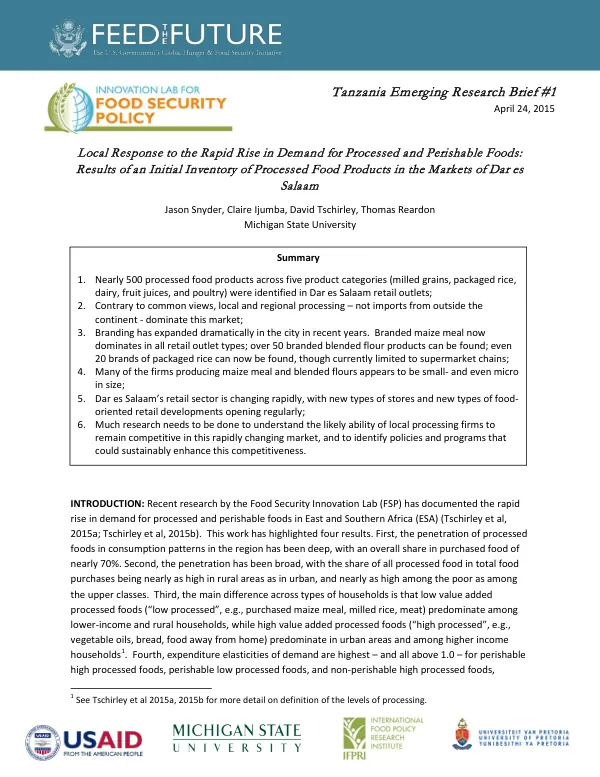
The rapid rise in demand for processed and perishable foods in East and Southern Africa has been documented by recent research by the Food Security Innovation Lab (FSP).
2015 · 5 pages
Sign in to readA free account is required to download.
Abstract
This growth has been driven by increasing income and urbanization in the region. As a result, market demand for perishable high processed products, perishable low processed products, and non-perishable high processed products is expected to increase by factors of 10, 8, and 7, respectively, over the next 30 years. This growth presents huge business opportunities for entrepreneurs in the region's agrifood system, with 7% to 8% annual growth in demand depending on the product group. A study conducted in Dar es Salaam, Tanzania, aimed to address the questions of what processed food products are currently available at retail in the country, to what extent these products are produced locally, and what is the size distribution of local firms. The research team collected data from a range of retail outlets in Dar es Salaam, including supermarket chains, small format supermarkets, dukas, and sokos. The team identified 486 processed food products across five product categories: milled grains, packaged rice, dairy, fruit juices, and poultry. The study found that local and regional processing dominate the market, with 61% of the identified products manufactured in Tanzania. Tanzania dominates the production of processed grains, packaged rice, dairy, and poultry, with imports from neighboring countries Kenya and Uganda accounting for 10% of all products found. The majority of local firms producing these products are small- and micro-sized, with over 50 branded blended flour products and 20 brands of packaged rice available in the market. The study also found that the retail sector in Dar es Salaam is changing rapidly, with new types of stores and new types of food-oriented retail developments opening regularly. This growth presents opportunities for entrepreneurs to establish new businesses and create employment opportunities in the post-farm segment of the region's agrifood system. However, the study also raises concerns about the potential for consolidation in the sector, which could lead to fewer workers being employed per unit of output. The study's findings have implications for policymakers and stakeholders seeking to support the growth of the processed food industry in Tanzania. The research highlights the need for further investigation into the competitiveness of local processing firms and the development of policies and programs that could sustainably enhance this competitiveness. The study also underscores the importance of understanding the size distribution of local firms and the market share held by micro-, small-, and medium-sized firms compared to local large firms and foreign firms.
Related documents