USAID DEC
Feed the Future Innovation Lab for Food Security Policy Research, Capacity, & Influence (PRCI)
Sign inINSTITUTE FOR INTEGRATED DEVELOPMENT STUDIES
Feed the Future Innovation Lab for Food Security Policy Research, Capacity, & Influence (PRCI)
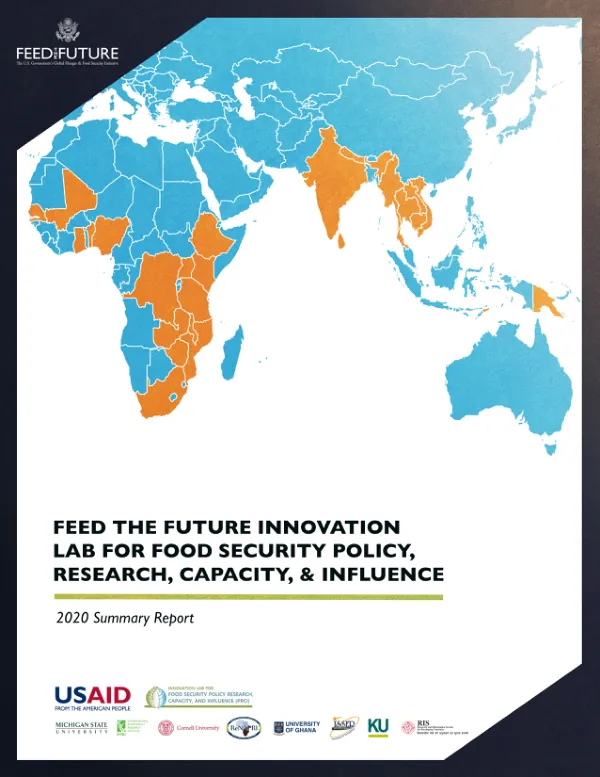
The Feed the Future Innovation Lab for Food Security Policy Research, Capacity, and Influence (PRCI) builds the capacity of local research centers and policy research networks in Africa and Asia to conduct research that impacts policy and programmatic decision making at national, regional, and continental levels.
2021 · 8 pages
Sign in to readA free account is required to download.
Abstract
By partnering with centers and networks that already have strong relationships with policymakers, PRCI ensures policy and programmatic influence from the start. PRCI's objectives are to build the research capacity of its partner centers, tie that research to policy priorities, and fund their institutional strengthening. This approach helps grow the reputation of these centers as sources of solid, evidence-based policy thinking, further increasing their influence. PRCI successfully navigated its first year of operation in the midst of a global pandemic, making major adjustments to its way of doing business while effectively implementing the core processes needed to put each of the partner centers in charge of their own capacity development. In Africa, PRCI works through the Regional Network of Agricultural Policy Research Institutes in Africa (ReNAPRI) and three Centers for Policy Leadership (CPLs) that were selected competitively during the Lab's first year. Researchers from two additional African research centers won STAAARS+ fellowships and are engaged in PRCI's research program. ReNAPRI is a network of 11 policy research centers across East and Southern Africa and Ghana, and PRCI has helped ReNAPRI achieve its vision of becoming an important player in regional and continental policy deliberations. In Asia, PRCI has partnered with two sub-regional leads to build out a network of policy research centers working on common research. Kasetsart University Department of Agricultural and Resource Economics (KU) serves as the capacity building and research hub for Southeast Asia, while Research and Information System for Developing Countries (RIS) in New Delhi plays the same role for South Asia. Working through KU and RIS, PRCI supports their efforts to strengthen their regional presence by partnering with associated centers in the sub-regions. To strengthen institutional capacity, PRCI works with selected policy research centers to improve existing internal systems and processes. In 2020, PRCI facilitated ReNAPRI's five-year strategic planning initiative via a series of virtual workshops and collaborative engagements. PRCI's technical training program is designed to support selected project-affiliated policy research centers in their conduct of research and policy communication using a trainer of trainer approach. The program has trained 30 researchers and developed 11 training modules. PRCI's Research-to-Policy (R2P) program builds on the policy knowledge and access of its partner centers to develop concrete strategies to bring its research to bear on policy making in the country. PRCI's institutional capacity strengthening program puts local partners in charge of their own capacity strengthening, with them and five national partner centers in the region. The program has helped ReNAPRI become a technical lead for preparations for the Abuja II Soil Fertility Summit and coordinates with the African Union Department of Trade to support implementation of the AU Commodities Strategy under the African Continental Free Trade Agreement. PRCI's work in Africa and Asia has been recognized for its impact, with researchers and policymakers praising the Lab's approach to building research capacity and influencing policy. PRCI's model of operating in a virtual environment has been particularly effective, with the Lab becoming a leader in how to meld enhanced remote interaction with smarter use of in-person engagement.