CATHOLIC RELIEF SERVICES ORGANIZATION
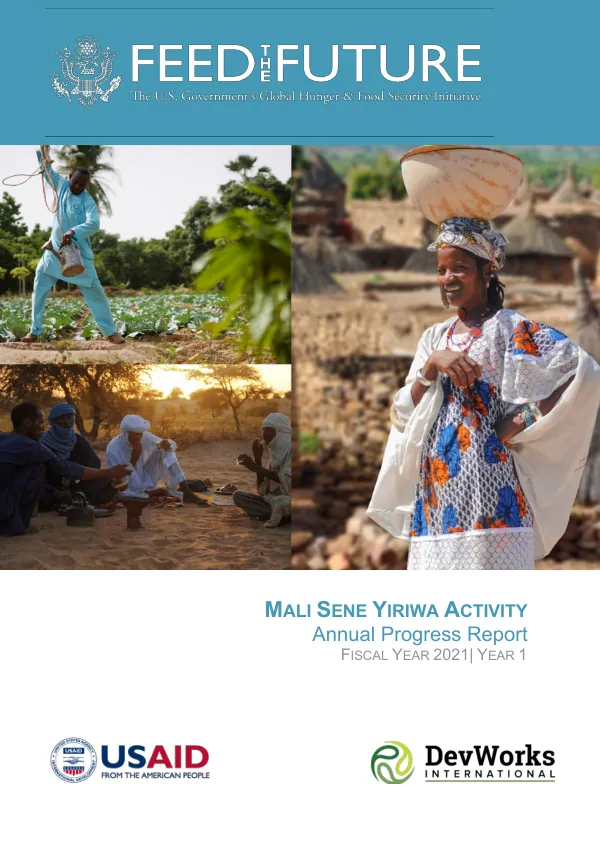
Feed the Future Mali Sene Yiriwa Annual Progress Report – Fiscal Year 2021/Year 1
The Feed the Future Mali Sene Yiriwa activity is a USAID-funded initiative aimed at improving agricultural productivity and income for smallholder farmers in Mali.
2021 · 83 pages
Sign in to readA free account is required to download.
Abstract
The activity began on January 27, 2021, and will conclude on January 26, 2026. The geographic focus of the activity is in the Cercles of Bandiagara, Bankass, Djenne, Douentza, Koro, Mopti, Tenenkou, Youwarou, Dire, Goundam, Niafunke, and Tombouctou. The activity's primary objective is to improve the delivery of quality products and services to smallholder farmers, increase productivity through climate-smart agriculture, and increase income availability without reducing household ability to farm. The activity also aims to reinforce community economic, health, and meteorological systems, improve water security, and increase the availability and sales of nutrient-dense food products. During the reporting period of January 27, 2021, to September 30, 2021, the activity achieved several key milestones. The producer access to inclusive markets expanded, with 1,200 farmers accessing markets through the activity's interventions. The activity also improved producer and producer organization access to financial services and information technologies, with 500 farmers accessing financial services and 200 producer organizations receiving training on information technologies. The activity's climate-smart agriculture interventions also showed positive results, with 80% of targeted producer organizations and private service providers receiving capacity building and knowledge sharing on climate-smart agriculture practices. The activity's inclusive, nutrition-sensitive, integrated agro-pastoral production increased, with 50% of targeted farmers adopting climate-smart agriculture practices. The activity's income generation interventions also showed positive results, with 30% of targeted farmers increasing their income through the activity's interventions. The activity's community economic, health, and meteorological systems reinforcement interventions also showed positive results, with 20% of targeted communities reporting improved natural resource management and conflict resolution. The activity's water security interventions also showed positive results, with 15% of targeted communities reporting improved access to clean water and sanitation facilities. The activity's private sector engagement and sustainability interventions also showed positive results, with 10% of targeted private sector partners reporting increased investment in the agricultural sector. The activity's monitoring, evaluation, and learning interventions also showed positive results, with 90% of targeted communities reporting improved access to information and data on agricultural productivity and income. The activity's collaboration with other Feed the Future Mali activities and other stakeholders in the Delta Zone also showed positive results, with 20% of targeted stakeholders reporting improved collaboration and coordination. The activity's expenditures for FY 2021 totaled $1.5 million, with 80% of funds allocated to program activities and 20% allocated to operations and management. The activity's planned activities for FY 2022|Q1 include the continuation of climate-smart agriculture interventions, income generation interventions, and community economic, health, and meteorological systems reinforcement interventions. The activity's resilience interventions also include the establishment of a resilience fund to support smallholder farmers in responding to climate-related shocks and stresses. The activity's nutrition interventions include the promotion of nutrient-dense food products and the establishment of nutrition-sensitive agriculture practices. The activity's cross-cutting issues interventions include the promotion of gender and youth inclusion, science, technology, innovation, and research, and environmental compliance and climate risk management. The activity's sustainability and local capacity development interventions include the establishment of a local capacity development fund to support the development of local institutions and capacities. The activity's policy and governance support interventions include the provision of technical assistance to the Government of Mali on agricultural policy and governance. The activity's collaboration with other stakeholders in the Delta Zone includes the establishment of a Delta Zone consortium to support collaboration and coordination among stakeholders. The activity's monitoring, evaluation, and learning interventions include the establishment of a monitoring and evaluation system to track progress and identify areas for improvement. The activity's deliverables include the establishment of a resilience fund, the promotion of nutrient-dense food products, and the establishment of nutrition-sensitive agriculture practices. The activity's operations, management, and staffing interventions include the establishment of a local office in the Delta Zone, the recruitment of local staff, and the establishment of a procurement system. The activity's risk management and security interventions include the establishment of a risk management plan and the provision of security training to local staff.
Related documents
Documents in this collection
 2024
2024USAID DEC
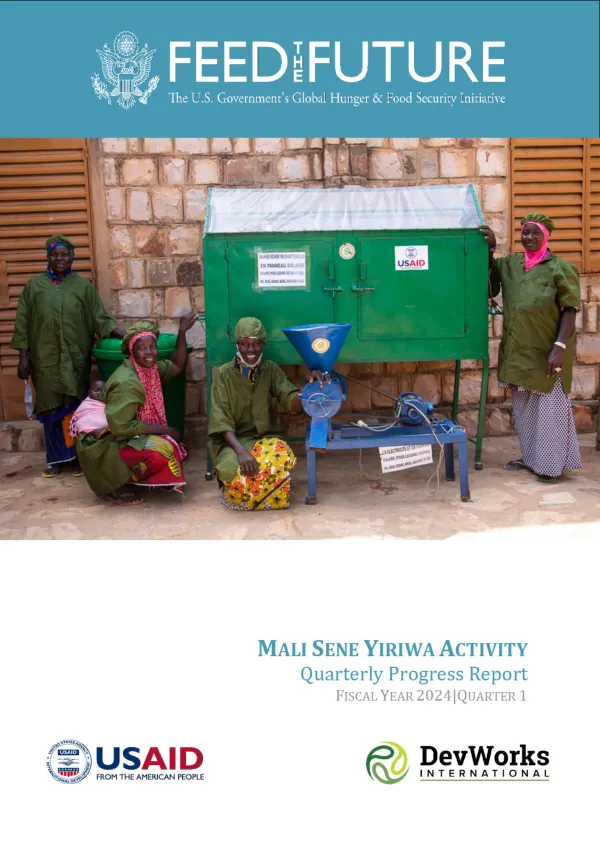
Feed the Future Mali Sene Yiriwa Quarterly Progress Report – Fiscal Year 2024|Quarter 1
Open record 2011
2011USAID DEC