USAID DEC
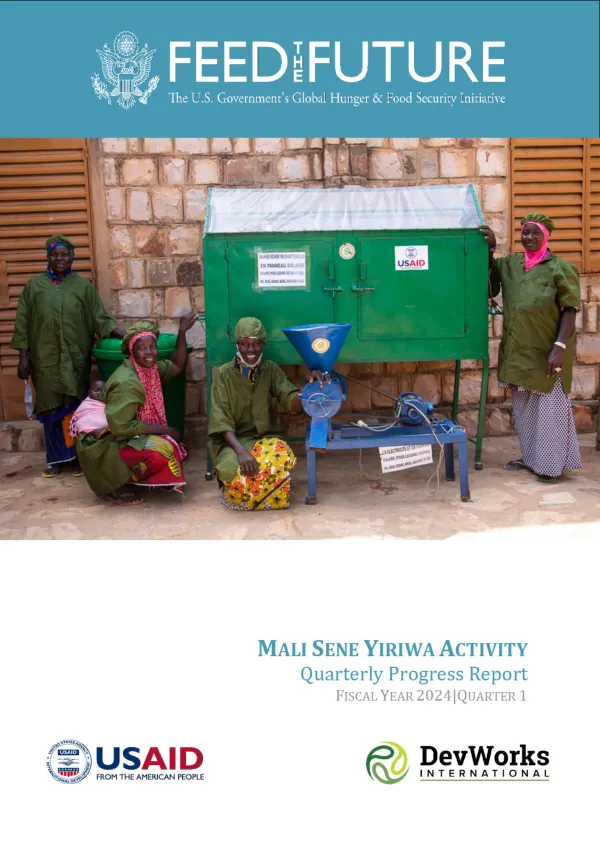
Feed the Future Mali Sene Yiriwa Quarterly Progress Report – Fiscal Year 2024|Quarter 1
Sign inCATHOLIC RELIEF SERVICES ORGANIZATION
Feed the Future Mali Sene Yiriwa Quarterly Progress Report – Fiscal Year 2024|Quarter 1
Feed the Future Mali Sene Yiriwa is a cooperative agreement between the United States Agency for International Development (USAID) and DevWorks International, with a start date of January 27, 2021, and an end date of January 26, 2026.
2024 · 63 pages
Sign in to readA free account is required to download.
Abstract
The agreement aims to improve agricultural productivity, increase income availability, and enhance community resilience in the Circles of Bandiagara, Bankass, Djenné, Douentza, Koro, Mopti, Tenenkou, Youwarou, Diré, Goundam, Niafunké, and Tombouctou in Mali. The activity focuses on three main impact results: IR 1.1, IR 1.2, and IR 2.1. IR 1.1 aims to improve delivery of quality products and services, with a focus on expanding producer access to inclusive markets and improving producer and producer organization access to financial services and information technologies. IR 1.2 targets increased productivity through climate-smart agriculture, with a focus on capacity and knowledge building of targeted producer organizations and private service providers, as well as inclusive, nutrition-sensitive, integrated agro-pastoral production. IR 2.1 aims to increase income availability without reducing household ability to farm, with a focus on diversity of economic activities and income sources. During the reporting period of October 1, 2023, to December 31, 2023, the activity made significant progress in achieving its impact results. Producer access to inclusive markets expanded, with 23 producer organizations and 15 private service providers participating in market linkage facilitation activities. Capacity and knowledge building of targeted producer organizations and private service providers increased, with 25 training sessions conducted on climate-smart agriculture practices. Inclusive, nutrition-sensitive, integrated agro-pastoral production increased, with 15 demonstration plots established in communities. The activity also made progress in increasing income availability without reducing household ability to farm. Diversity of economic activities and income sources increased, with 30% of participating households engaging in non-farm income-generating activities. The activity also reinforced community economic, health, and meteorological systems, with a focus on preventing and mitigating natural resource conflicts. Challenges encountered during the reporting period included equipment costs for irrigation techniques and limited access to financial services for women-headed households. Measures taken to address these challenges included providing training on sustainable agriculture practices and facilitating access to financial services through partnerships with local banks. The activity also made progress in increasing the availability and sales of nutrient-dense food products. Production and availability of nutrient-dense food products increased, with 15 producer organizations participating in value chain development activities. The activity also collaborated with Feed the Future Mali Sugu Yiriwa Activity in the Delta Zone and other USAID Mali activities to leverage resources and expertise. In terms of resilience, the activity made progress in improving the understanding of the impact of pastoral populations, livestock, and irrigation on wetlands. The activity also implemented measures to prevent and mitigate natural resource conflicts, with a focus on community engagement and conflict resolution. The activity's monitoring, evaluation, and learning plan is designed to track progress towards its impact results and identify areas for improvement. The plan includes regular data collection and analysis, as well as quarterly progress reports and annual evaluation reports. Overall, the Feed the Future Mali Sene Yiriwa activity made significant progress in achieving its impact results during the reporting period of October 1, 2023, to December 31, 2023. The activity's focus on improving agricultural productivity, increasing income availability, and enhancing community resilience has contributed to improved food security and economic growth in the target communities.