USAID DEC
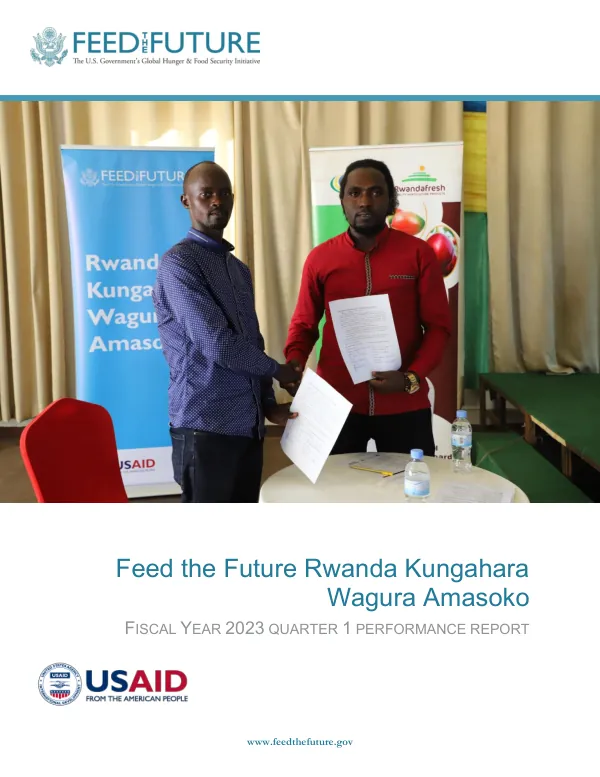
Feed the Future Rwanda Hanga Akazi Activity FISCAL YEAR 2023 QUARTER 1 PROGRESS REPORT
Sign inMINISTRY OF INTERNATIONAL TRADE AND INDUSTRY OF JAPAN
Feed the Future Rwanda Hanga Akazi Activity FISCAL YEAR 2023 QUARTER 1 PROGRESS REPORT
Rwanda's transformative vision emphasizes skills development and employment promotion as key drivers of economic growth.
2023 · 30 pages
Sign in to readA free account is required to download.
Abstract
However, Rwanda's skills base remains a constraint to enterprise growth, and limited information flow between job seekers and employers creates lingering mismatches in the labor market. To address this challenge, the Feed the Future Rwanda Hanga Akazi Activity (HA) has been working to increase Rwandans' knowledge and skills required to serve labor and consumer markets domestically, regionally, and globally. HA's interventions under Intermediate Result 1 (IR 1) focused on defining and solidifying the skills baseline and building strong working relationships with key market actors, including the Government of Rwanda (GOR), Technical and Vocational Education and Training (TVET) institutions, Integrated Polytechnic Regional Colleges (IPRCs), and the private sector. This involved reviewing existing literature, mapping stakeholders, and consulting with targeted industry champions and partners to identify mutually beneficial opportunities. One key activity under IR 1 was the launch of a labor market assessment procurement, which will assess sectoral skills gaps that constrain demand-led workforce development. This assessment aims to support a well-functioning and inclusive skills-development ecosystem that matches job seekers with job opportunities. By conducting this assessment, HA seeks to identify areas where skills development interventions can be most effectively targeted to address labor market constraints. In addition to the labor market assessment, HA has been working to build strong working relationships with key market actors. This includes collaborating with the GOR's Ministry of Trade and Industry (MINICOM), Rwanda Development Board (RDB), and Ministry of Public Service and Labor to identify mutually beneficial opportunities for skills development and employment promotion. By working closely with these stakeholders, HA aims to ensure that its interventions are aligned with the GOR's priorities and goals. Overall, HA's efforts under IR 1 are focused on building a strong foundation for skills development and employment promotion in Rwanda. By conducting a labor market assessment and building strong working relationships with key market actors, HA aims to identify areas where skills development interventions can be most effectively targeted to address labor market constraints and promote economic growth. HA also made progress in improving private sector access to resources required to grow revenue and employment. The project shortlisted and conducted site visits to 17 prioritized firms to explore partnership opportunities, and identified six potential firms to participate in a social-inclusion champions campaign aimed at documenting the business case for inclusive practices. This campaign aims to drive wider-spread adoption of inclusive practices among businesses in Rwanda. In addition to its work under IR 1 and IR 2, HA also made progress in building a consistent framework for and understanding of project implementation across components. All project staff completed gender, equity, and social inclusion (GESI) and communications training, which set a foundation for the integration of GESI perspectives throughout the project life cycle. This training will help ensure equal opportunities for women, youth, and persons with disability in project interventions. Overall, HA's progress in Q1 has laid the foundation for its future interventions. By building strong working relationships with key market actors, conducting a labor market assessment, and promoting inclusive business practices, HA is well-positioned to make a positive impact on Rwanda's labor market and promote economic growth.