USAID DEC
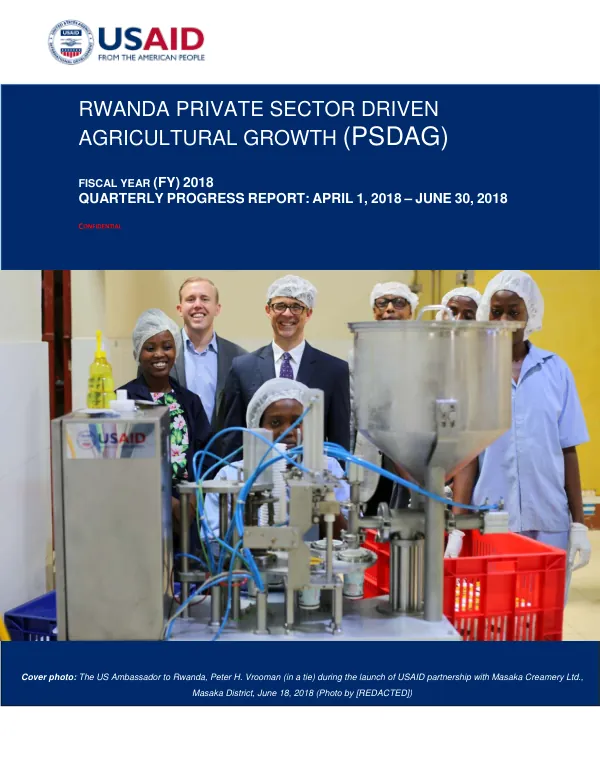
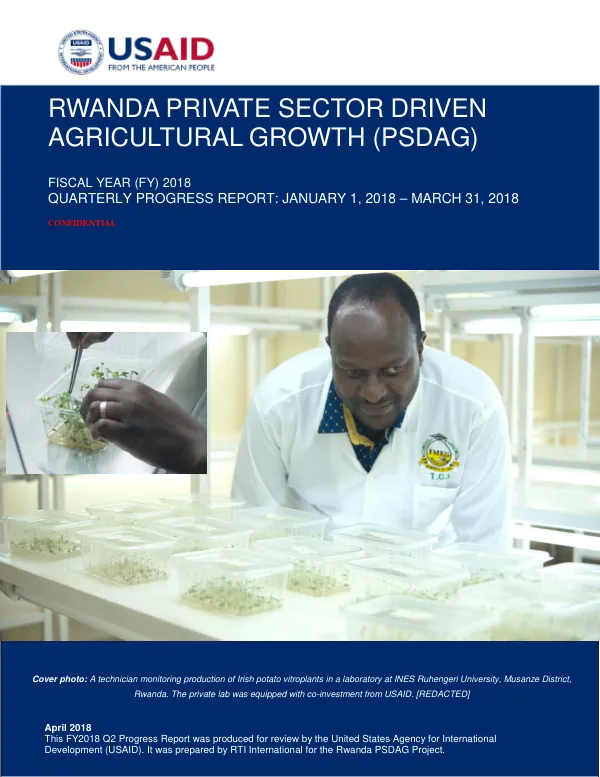
Rwanda Private Sector Driven Agricultural Growth (PSDAG) Project FY2018 Q2 Progress Report
Sign inRTI INTERNATIONAL
Rwanda Private Sector Driven Agricultural Growth (PSDAG) Project FY2018 Q2 Progress Report
The Rwanda Private Sector Driven Agricultural Growth (PSDAG) Project is a USAID-funded initiative aimed at increasing private sector investment in Rwanda's agricultural sector.
2018 · 101 pages
Sign in to readA free account is required to download.
Abstract
The project began in 2015 and is implemented by RTI International. The FY2018 Q2 Progress Report, covering the period from January 1 to March 31, 2018, highlights the project's progress in achieving its objectives. Objective 1.1 of the project focuses on assisting the Government of Rwanda (GOR) to increase private sector investment. Key milestones and partnerships were established during the quarter, including the signing of a Memorandum of Understanding (MOU) with the Development Bank of Rwanda (BRD) to provide financing to private sector companies. Activities undertaken during the quarter included the provision of technical assistance to private sector companies, the development of business plans, and the facilitation of partnerships between private sector companies and government agencies. Objective 2 of the project aims to facilitate increased private sector investment to upgrade value chains. During the quarter, the project selected and approved private partners, including the Kenya Commercial Bank (KCB) Rwanda, to provide financing to private sector companies. Activities undertaken during the quarter included the provision of technical assistance to private sector companies, the development of business plans, and the facilitation of partnerships between private sector companies and government agencies. The project also focuses on monitoring and evaluation, social inclusion, communication, capacity building, and knowledge management. During the quarter, the project conducted monitoring and evaluation activities, including the collection of data on project outcomes and the assessment of project impact. The project also undertook social inclusion activities, including the provision of training to women and youth on business development services. The project has established partnerships with various organizations, including the Development Bank of Rwanda (BRD), the Kenya Commercial Bank (KCB) Rwanda, and the Access to Finance Rwanda (AFR). These partnerships aim to provide financing to private sector companies and facilitate the development of business plans. The project has made significant progress in achieving its objectives, including the provision of technical assistance to private sector companies, the development of business plans, and the facilitation of partnerships between private sector companies and government agencies. The project has also established partnerships with various organizations to provide financing to private sector companies and facilitate the development of business plans. The project's progress is measured through various indicators, including the number of private sector companies receiving technical assistance, the number of business plans developed, and the number of partnerships established between private sector companies and government agencies. The project's outcomes are also assessed through monitoring and evaluation activities, including the collection of data on project outcomes and the assessment of project impact. The project's success is attributed to the strong partnerships established with various organizations, including the Development Bank of Rwanda (BRD), the Kenya Commercial Bank (KCB) Rwanda, and the Access to Finance Rwanda (AFR). These partnerships have enabled the project to provide financing to private sector companies and facilitate the development of business plans. The project's future plans include continuing to provide technical assistance to private sector companies, developing business plans, and facilitating partnerships between private sector companies and government agencies. The project also plans to continue its monitoring and evaluation activities to assess project impact and outcomes. The project's geographic focus is Rwanda, with a specific emphasis on the agricultural sector. The project's timeframes are from 2015 to 2020, with the FY2018 Q2 Progress Report covering the period from January 1 to March 31, 2018. The project's recommendations include continuing to provide technical assistance to private sector companies, developing business plans, and facilitating partnerships between private sector companies and government agencies.
Related documents