USAID DEC
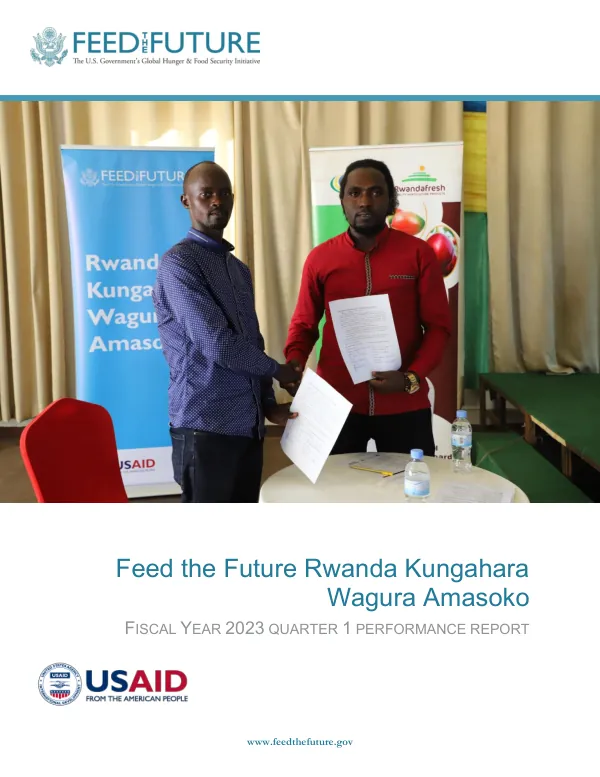
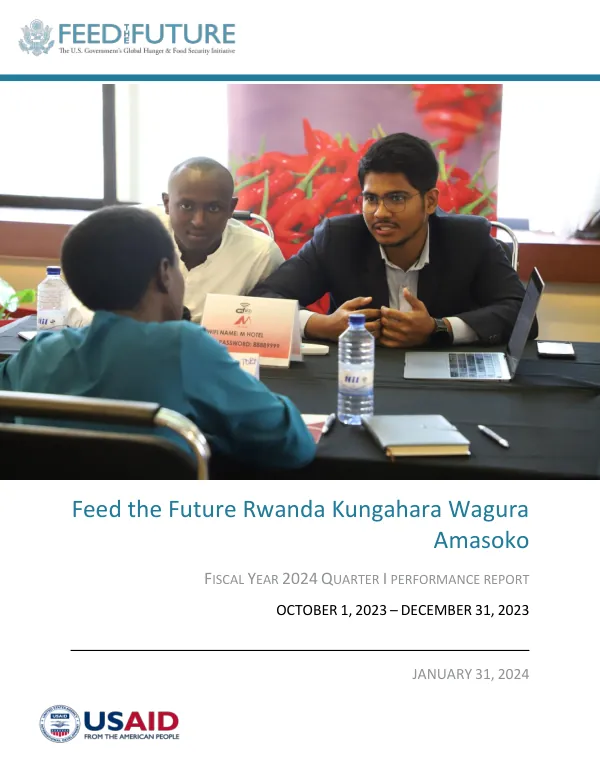
Feed the Future Rwanda Kungahara Wagura Amasoko FY 2024 Quarter 1 Activity Performance Report
Sign inRTI INTERNATIONAL
Feed the Future Rwanda Kungahara Wagura Amasoko FY 2024 Quarter 1 Activity Performance Report
The project, Feed the Future Rwanda Kungahara Wagura Amasoko, aims to support the growth of Rwanda's high-value agricultural export by working with the Government of Rwanda, the private sector, and civil society organizations.
2024 · 101 pages
Sign in to readA free account is required to download.
Abstract
The project has two strategic objectives: to create an inclusive and resilient policy and regulatory environment, and to support local actors to attract investment to the sector. The project focused on contracting, rolling out, and monitoring assignments directed at the Government of Rwanda, the private sector, and private sector partners. In Quarter 1 of Year 3, 17 assignments were contracted and rolled out. The assignments included work with the National Agricultural Export Development Board (NAEB) on a five-year development strategy, a feasibility study for Nyamagabe, and improving the functionality of NAEB's online export service platform. On the private sector side, a total of 10 assignments were rolled out, including piloting digital financial products for working capital with three small and medium enterprises (SMEs), coaching on different certification requirements for 15 SMEs, and coaching on financial and compliant reporting for two SMEs. The project also rolled out the Rwanda Youth in Agribusiness Forum (RYAF) strategic review in Quarter 1 to improve the advocacy, inclusion, and resource mobilization of the forum. The project received supplementary funding to buffer the high-value horticulture sector from shocks related to the Russia-Ukraine war. In Quarter 1 of Year 3, the project selected 11 SMEs to invest in air freight and anticipates USAID approvals and grant roll-out in Quarter 2. The project also finalized the selection of 12 applicants for cold chain co-investment. The project aims to ensure that the selected SMEs invest 40 percent of the truck cost, with the remaining 60 percent covered by the project. To ensure inclusivity, the project will release a request for proposals targeting export firms led by or impacting women, youth, and persons with disabilities for air freight co-investment. The project has also analyzed resilient business models for high-value agriculture exporters and viable business models for cold chain transport with a focus on refrigerated trucks. The cold chain transportation model for refrigerated trucks was rolled out in Quarter 1, and the results will be presented to stakeholders in the coming quarter. The project has made significant progress in Quarter 1 of Year 3, with a focus on contracting, rolling out, and monitoring assignments directed at the Government of Rwanda, the private sector, and private sector partners. The project aims to create an inclusive and resilient policy and regulatory environment and to support local actors to attract investment to the sector. The project has also received supplementary funding to buffer the high-value horticulture sector from shocks related to the Russia-Ukraine war. The project aims to ensure that the selected SMEs invest 40 percent of the truck cost, with the remaining 60 percent covered by the project. The project will release a request for proposals targeting export firms led by or impacting women, youth, and persons with disabilities for air freight co-investment.
Related documents