USAID DEC
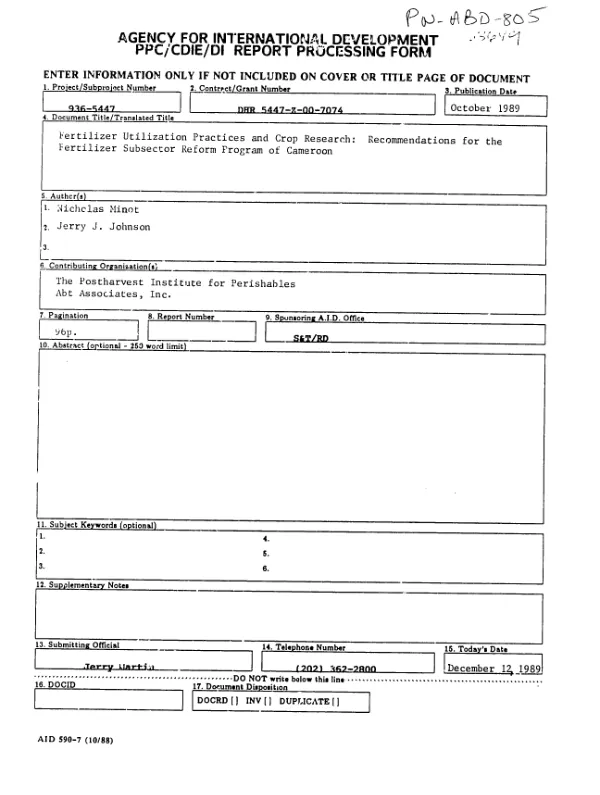
Fertilizer utilization practices and crop response research : recommendations for the fertilizer sub-sector reform program of Cameroon
Sign inABT ASSOCIATES, INC.
Fertilizer utilization practices and crop response research : recommendations for the fertilizer sub-sector reform program of Cameroon
Since the mid-1970"s, fertilizer consumption in Cameroon has tripled to over 100,000 metric tons per year, 60% of which is subsidized.
Minot, Nicholas; Johnson, Jerry J. · 1989
Sign in to readA free account is required to download.
Abstract
However, the use of fertilizer varies considerably among provinces, with the West, Littoral, and the three northern provinces representing three-quarters of total fertilizer consumption, and the South and Center Provinces together accounting for less than 2%. Part I of this report analyzes the reasons behind the unevenness of fertilizer use in Cameroon. To a large degree, the patterns reflect the different crops grown in each province. Cotton, coffee, and food crops, the important crops in the areas of high fertilizer use, are usually fertilized in all areas. By contrast, cocoa and root crops, the most significant in the South and Center, are rarely fertilized. However, even for a given crop, fertilization rates are higher in the provinces of high overall fertilizer consumption. This may be because greater use of fertilizer in a region helps establish supply lines which, in turn, facilitate fertilizer use among farmers who would not otherwise use it. Additional factors affecting fertilizer use include farmers" purchasing power, cropping patterns, distance to major roads, population density, and the effectiveness of local supply institutions such as cooperatives. Part II of the report reviews fertilizer crop response research in Cameroon, including projects to improve coffee, maize, andd other food crop yields. Recommendations are then presented for future research activities, such as the development of a national fertilizer response database, on-farm fertilizer response trials, farmer demonstrations, strengthening of governmental research institutions, and soil ecology.