AFRICARE, INC.
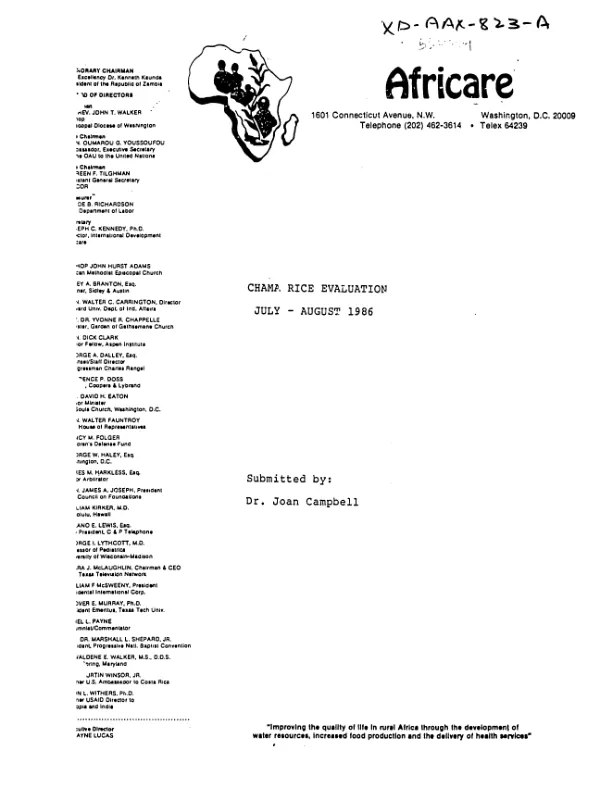
Final analysis of the Chama rice project
Final report by the grantee, Africare, on a project (1981-86) to increase rice production and small farmer income in three areas of Zambia"s Chama District.
McLeod, Matthew A. · 1970
Sign in to readA free account is required to download.
Abstract
The project did increase rice production (primarily by introducing mechanized cultivation and intensive farming techniques), but it is impossible to measure the degree of its success in this regard. The available baseline data were neither complete nor accurate, and subsequent data necessarily reflect sociological and environmental factors (e.g., the yearly distribution of land; the shared nature of cultivation and labor, extending sometimes beyond the project areas; and floods). Nonetheless it is certain that the number of farmers involved in the project grew dramatically, and hectarage cultivated, yield per ha, and net income rose similarly. While the amount of rice marketed also increased, the percentage brought to market declined, the difference possibly having been consumed or exchanged for farm labor. The project"s experience with agricultural extension and support services was mixed. These activities were designed to depend heavily on inputs from the Government of Zambia (GRZ), which were not always provided as agreed. For example, the GRZ did not field a full complement of extension personnel, and the personnel provided were neither well trained nor motivated. The successful formation of farm management groups (which are doing an excellent job of maintaining the tractors and other equipment supplied by the project) was a notable achievement, however. In addition, a seed purification/multiplication program (varietal testing and transplantation techniques) was initiated; although its real results will not be seen for one or two more years, some farmers have already adopted faster maturing varieties. Planned road construction faltered, due to inaccurate cost estimates and lack of GRZ leadership, but some work was done on a self-help basis and housing and shed construction progressed generally as planned. The project"s most obvious lesson is the need for an accurate baseline study. Next, sociological considerations should be given equal weight with technical ones - it was lack of coordination and insufficient elicitation of people"s (rather than just the GRZ"s) input that caused most of the project"s problems. Similar projects in the future should include: erosion monitoring and management; wet-period rice cultivation to facilitate transplantation and save on hand labor; credit for participants; adequate accounting skills (the GRZ failed in this regard); and more concentration on self-help aspects.