USAID. MISSION TO GUINEA-BISSAU
Project activities completion report rice production (657-0009) : Guinea-Bissau
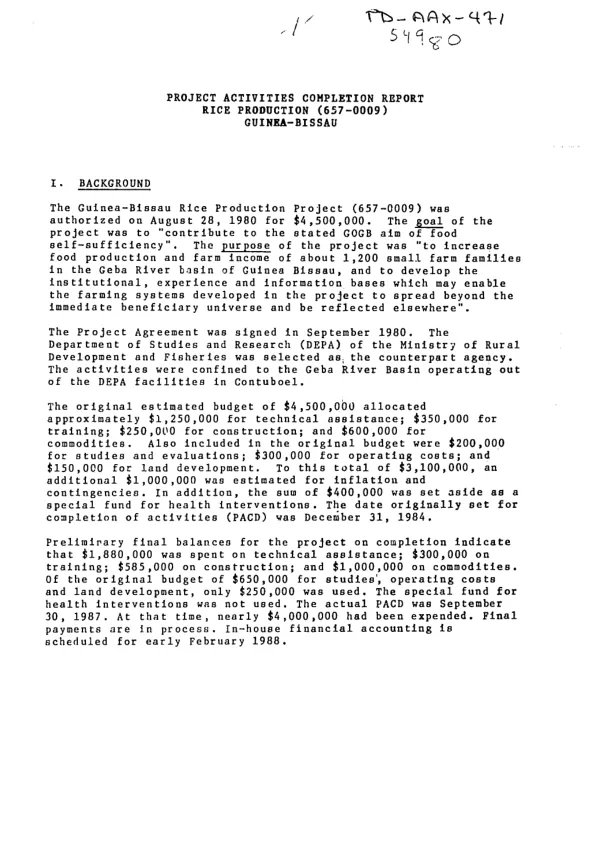
Project Activities Completion Report on a project (9/80-9/87) on a project to develop an improved technical package for rice production in the Geba river valley of Guinea-Bissau.
1988
Sign in to readA free account is required to download.
Abstract
The project has made significant contributions - it has laid the groundwork for future agricultural improvements and it has taught some valuable lessons, especially regarding technology development. Original plans to introduce pump irrigation were soon dropped in favor of a more logical intervention, contour diking (which, however, was decided upon without being tested under local conditions). The dikes were introduced fairly successfully, along with fertilizers, pesticides, and improved seeds, on 416 ha, enabling 1,310 families to increase crop yields and food availability, but not necessarily their incomes - it is not certain that the higher yields are sufficient to offset increased production costs. However, the technology has not been diffused beyond the original project area, nor is it sustainable in this area without continued project support. These shortcomings occurred because the technology was not tested under local conditions, and modified accordingly (which would have taken more time than was allotted for the TA team). Credit, extension, and hydrology units were organized within the cooperating agency - Guinea-Bissau"s Department of (Agricultural) Studies and Research (DEPA). However, the extension unit is not sustainable, given the host country"s limited resources; moreover, until a better technical package is developed, there is little for the unit to extend (nor was the unit much involved in actual extension activities during this project). Also in doubt are the sustainability of the credit unit and its appropriateness within a public agency. The targeted Geba River Valley Development Plan was not produced, and finally, while experimental farmers" committees were organized and operate under DEPA supervison, their effects are either unmeasurable or marginal. Key needs for the future are to integrate production with marketing, focus on the entire farming system (not rice alone), and continue TA for DEPA. The major lessons learned concern (1) institution building (3 years of TA is not enough, realistic goals should be set, and training should be directed at all levels of an organization, not just professional staff) and (2) the development of new technologies (research must be site-specific, tested under local conditions, and tried by farmers before replication).