CARGILL TECHNICAL SERVICES, INC.
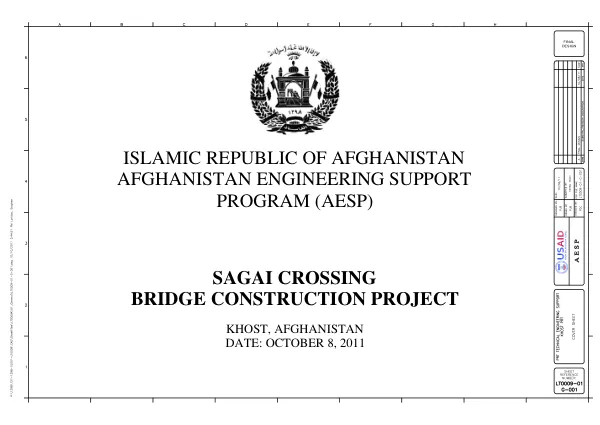
Final Design: SAGAI CROSSING BRIDGE CONSTRUCTION PROJECT
The SAGAI CROSSING BRIDGE CONSTRUCTION PROJECT is located in Khost, Afghanistan.
2011 · 34 pages
Sign in to readA free account is required to download.
Abstract
The project involves the construction of a bridge over the Sagai River, which is a critical transportation artery in the region. The bridge will provide a vital link between the provinces of Khost and Paktia, facilitating the movement of people, goods, and services. The bridge design is based on a reinforced concrete structure with a span of 117.8 meters. The superstructure consists of a series of simply supported spans, with a total length of 117.8 meters. The bridge will have a width of 7.3 meters, with a 3.65-meter-wide roadway and 1.825-meter-wide sidewalks on either side. The bridge will be designed to withstand a 50-year flood event, with a design flood discharge of 1,500 cubic meters per second. The bridge's foundation system consists of a combination of piers and abutments. The piers will be founded on rock, while the abutments will be founded on a combination of rock and soil. The bridge's superstructure will be supported by a series of beams, with a total of 12 spans. The beams will be designed to resist the loads imposed by the bridge's superstructure, as well as the loads imposed by the river's flow. The bridge's construction will involve a number of different activities, including excavation, concrete placement, and steel reinforcement. The project will also involve the construction of a number of ancillary structures, including a culvert and approach slab. The bridge's design and construction will be carried out in accordance with the standards and specifications of the Afghanistan Engineering Support Program (AESP). The bridge's design has been developed in accordance with the principles of good engineering practice, with a focus on safety, durability, and sustainability. The bridge's design has been reviewed and approved by a number of different stakeholders, including the AESP, the Afghan Ministry of Public Works, and the World Bank. The bridge's construction is expected to be completed within a period of 18 months, with a total budget of $2.5 million.
Related documents