USAID. MISSION TO ETHIOPIA
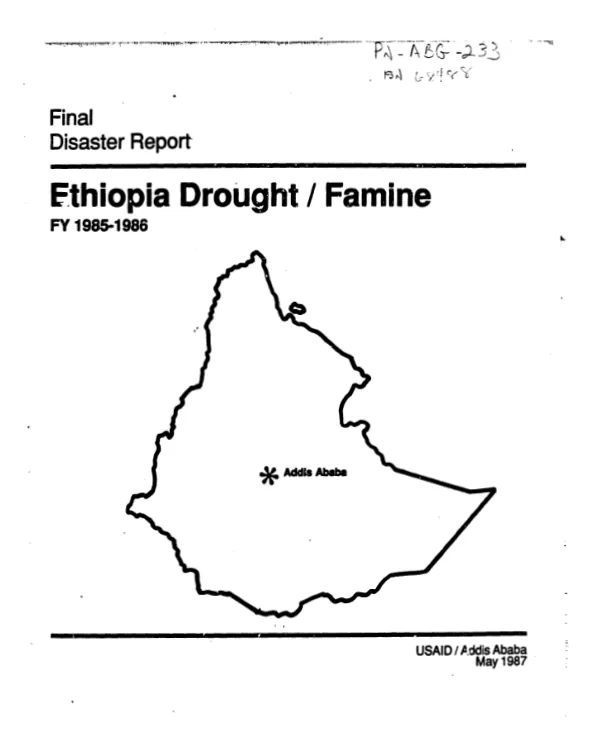
Final disaster report : Ethiopia drought/famine, FY 1985-1986
In 1984, the world came to know the state of the famine victims in Ethiopia.
1987
Sign in to readA free account is required to download.
Abstract
By the end of 1984, with nearly 8 million people in the country considered at risk of death due to starvation, appeals were made for 1.3 million mt of food, in addition to millions of dollars in other emergency relief supplies. The response was tremendous. Over 1.5 million mt of emergency food was distributed at the height of the famine, reaching an estimated 7.1 million people. At the same time, nearly $1 billion was provided by the international community in non-food relief aid, logistical support, and recovery programs. More than 60 organizations directly administered relief assistance, receiving donations from 36 different governments and innumerable individuals and private organizations. In response to the crisis, the U.S. government (USG) launched the largest ever emergency relief effort. Between 1984-1986, nearly $500 million of USG emergency assistance was granted to Ethiopia, most of it in the form of some 800,000 mt of food aid, which was distributed largely by NGO"s. Additionally, nearly $60 million in grants were given for emergency provisions and agricultural recovery measures, ranging from a massive food airlift (nearly $17 million) to blankets, from medical supplies to food monitors, from the establishment of a huge UN-managed truck fleet to the purchase of oxen. The response of the USG was even more remarkable since U.S. development assistance to Ethiopia had ceased in 1979, and there was no A.I.D. office in Ethiopia in 1984. Even at the height of the USG response, the A.I.D. staff was limited by the Government of Ethiopia to only four career A.I.D. officers and one secretary. This small group had the responsibility of managing nearly one-half billion dollars worth of emergency aid. Fortunately, this office was also able to rely upon a handful of U.S. citizens who joined the office on personal services contracts, a small group of skilled and dedicated Ethiopian employees, and TDY assistance from Washington and REDSO/Nairobi. In addition, most of the USG emergency assistance was channelled through NGO"s and supported by the UN and the Government of Ethiopia"s Relief and Rehabilitation Commission. This study reviews the details of the crisis from 1984-1986 and the U.S. response, including: mix and values of commodities and other relief items supplied; office organization; logistics; a review of NGO operations; and other matters pertinent to the final documentation of the relief effort. Recommendations are presented which may be useful in the implementation of future emergency assistance programs. (Author abstract sans adjectives)
Related documents
Documents in this collection
 1996
1996USAID DEC
OFDA participation in Operation Joint Endeavor -- lessons learned
Open record![Action plan for fiscal year 2004 : American Red Cross -- municipal disaster mitigation activities, El Salvador : activity no. and title -- 519-058 [i.e. 519-0458] earthquake recovery program](https://covers.devme.ai/gen/15419.webp) 2004
2004USAID DEC