STEERING COMMITTEE OF THE JOINT EVALUATION OF EMERGENCY ASSISTANCE TO RWANDA
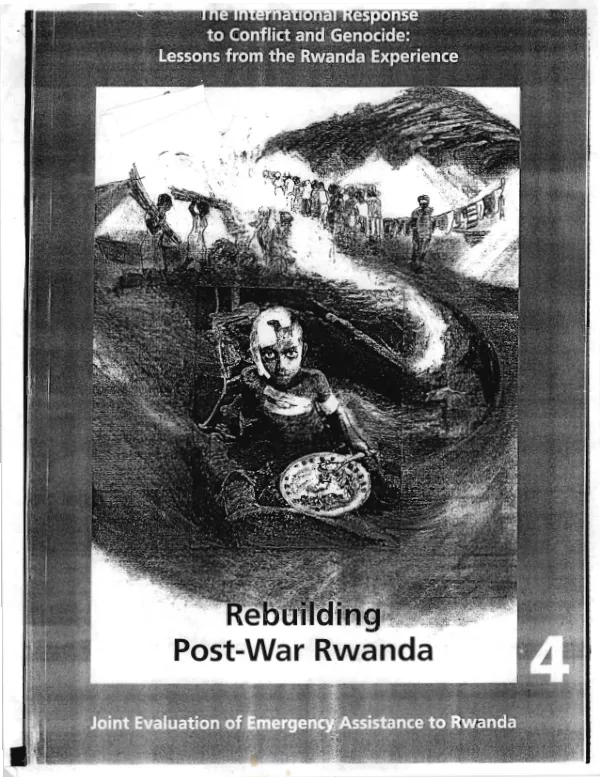
Rebuilding post-war Rwanda
International assistance to Rwanda in the aftermath of the violence that severely damaged many of the country"s social, cultural, and economic institutions is assessed in this report, which covers support for economic and public sector management, agriculture, the health and education sectors, vulnerable populations, psychosocial healing, promotion of human rights and development of a fair judicial system, and the return of refugees and internally displaced persons.
Kumar, Krishna; Tardif-Douglin, David G. · 1996
Sign in to readA free account is required to download.
Abstract
The report finds that international response to the humanitarian crisis provoked by the civil war and genocide has been generous and, in the emergency phase, rapid. It also finds, however, that ambiguity about objectives, the legitimacy and capacity of the new government and durability of peace, coupled with more deliberate processes for development assistance, have led to delays in assistance for reconstruction and development. In some cases, simple political miscalculations have led to impasses between the government and donors; in particular, by treating the crisis for the most part like any other civil war, the international community devalued the tragic social and human dimensions of the genocide, most lamentably perhaps by its rush to promote reconciliation over the understandable resistance of those who had suffered immensely. In any case, the international community cannot be expected to do everything, nor should it try to do so. Lessons learned from the Rwanda experience for future complex emergencies include the following. (1) Mechanisms for rapid delivery of rehabilitation assistance should be developed so as to shorten the transition from emergency assistance to reconstruction aid. There is a relationship between political instability plus economic stagnation and complex emergencies. Any delays in programs to rehabilitate social, political, and economic structures of a country emerging from a war put earlier gains at great risk. (2) Self-regulation of the NGO community would improve impact and ensure optimal use of the vast resources expended during the rehabilitation phase. A comprehensive code of conduct would improve accountability and the efficacy of NGO relief agencies. (3) Interventions should stress political and social reconstruction, focusing on the judiciary and the development of institutions of civil society. The collapse of political and social institutions is a key factor that differentiates complex emergencies from natural disasters. (4) Mechanisms for sharing background information about the historical, political, social, and economic contexts in countries in crisis should be institutionalized.