USAID DEC
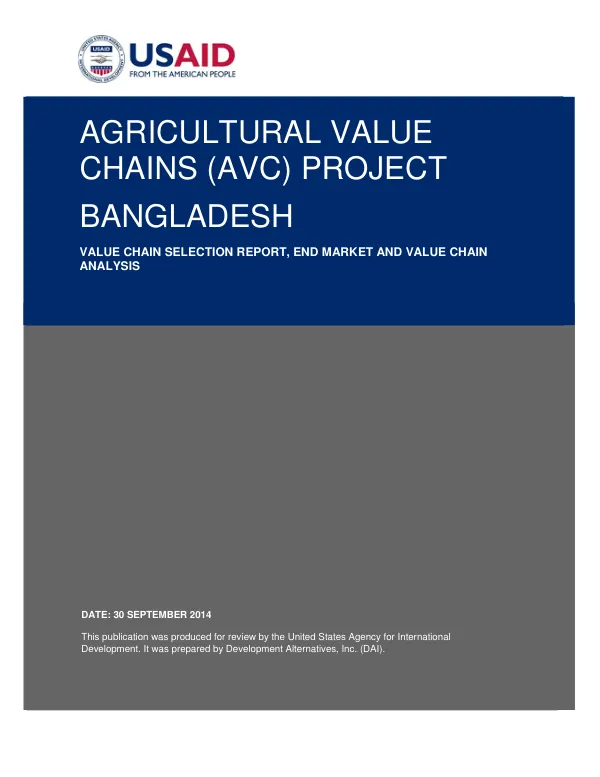
Final EMA: Value Chain Selection Report, End Market and Value Chain Analysis for the USAID Agricultural Value Chain (AVC) Project in Bangladesh
Sign inDEVELOPMENT ALTERNATIVES, INC./FINNET
Final EMA: Value Chain Selection Report, End Market and Value Chain Analysis for the USAID Agricultural Value Chain (AVC) Project in Bangladesh
The USAID Agricultural Value Chain (AVC) Project in Bangladesh aimed to improve the competitiveness and sustainability of selected agricultural value chains.
2014 · 226 pages
Sign in to readA free account is required to download.
Abstract
The project focused on identifying and analyzing the end market and value chain for various crops, including pulses, potato, summer vegetable basket, mangoes, tomatoes, groundnuts, and natural fibers. The project's methodology involved conducting a thorough assessment of each value chain, including end market analysis, market segments, production and post-harvest handling, and market channels. The assessment also included a scoring matrix and Porter's Five Forces analysis to evaluate the competitiveness of each value chain. The pulses value chain was identified as a priority area for the project, with lentil and mungbean production being the primary focus. The assessment revealed that the production costs and profitability of pulses were relatively low, making them an attractive option for farmers. However, the post-harvest handling and processing of pulses in the FTF zone were identified as areas for improvement. The potato value chain was also assessed, with a focus on production and post-harvest handling. The assessment revealed that the production costs and profitability of potatoes were relatively high, making them a more challenging crop for farmers to produce. However, the potato channel map and value chain actors were identified as key areas for improvement. The summer vegetable basket value chain was also assessed, with a focus on end market analysis and production practices. The assessment revealed that the production practices for summer vegetables were relatively low-cost and profitable, making them an attractive option for farmers. However, the post-harvest handling and market channels for summer vegetables were identified as areas for improvement. The mangoes value chain was also assessed, with a focus on post-harvest handling and market channels. The assessment revealed that the post-harvest handling of mangoes was relatively low-cost and profitable, making them an attractive option for farmers. However, the market channels for mangoes were identified as areas for improvement. The tomatoes value chain was also assessed, with a focus on Porter's Five Forces analysis and end market analysis. The assessment revealed that the production costs and profitability of tomatoes were relatively high, making them a more challenging crop for farmers to produce. However, the post-harvest handling and dynamic trend of tomatoes were identified as key areas for improvement. The groundnuts value chain was also assessed, with a focus on Porter's Five Forces analysis and end market analysis. The assessment revealed that the production costs and profitability of groundnuts were relatively low, making them an attractive option for farmers. However, the post-harvest handling and processing of groundnuts were identified as areas for improvement. The natural fibers value chain was also assessed, with a focus on jute and coir production. The assessment revealed that the production costs and profitability of jute and coir were relatively low, making them attractive options for farmers. However, the post-harvest handling and processing of jute and coir were identified as areas for improvement. Overall, the project's assessment revealed that the selected value chains had varying levels of competitiveness and sustainability. The project's recommendations included improving post-harvest handling and processing, enhancing market channels, and increasing the adoption of best practices among farmers.
Related documents