USAID DEC
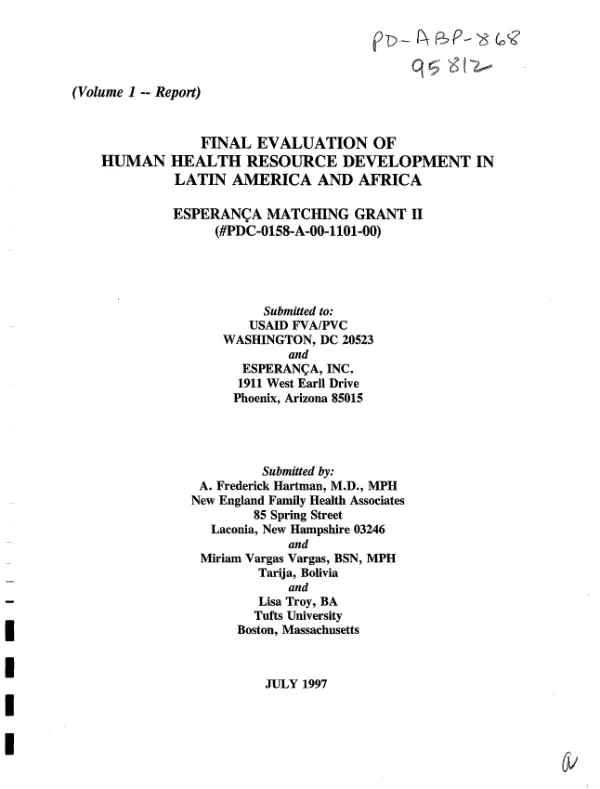
Final evaluation of human health resources development in Latin America and Africa : Esperanca matching grant II (PDC-0158-A-00-1101-00)
Sign inESPERANCA, INC.
Final evaluation of human health resources development in Latin America and Africa : Esperanca matching grant II (PDC-0158-A-00-1101-00)
Final evaluation of a matching grant provided to Esperanca (9/91-9/97) to improve health care administration, especially in the public sector, in Latin America and Africa.
Hahrtman. A. Frederick|Vargas, Miriam Vargas · 1997
Sign in to readA free account is required to download.
Abstract
The project involves South-South technology transfer and networking between Esperanca programs in Bolivia and Brazil, the rest of Spanish-speaking Latin America, and Portuguese-speaking African countries, such as Mozambique and Guinea-Bissau. The project has exceeded its quantitative goals for graduate training of public health officials and for NGO workshops, as well as for the number of training sessions held, and overall outputs. What is more, the graduate program has evolved into the only Masters in Public Health (MPH) program for the public sector in Bolivia; it was also adapted for a specialized course in public health in Brazil. In addition, the Masters in Administration of Public Health (MAPH) is currently underway. A series of 12 workshops was provided to NGOs in Bolivia and Brazil. Both of these countries have developed their capacities to provide workshops in technical areas requested by NGOs or other private or semi-government organizations, such as utilities. Based on surveys and site visits, participants were highly satisfied with the project's offerings. In fact, a number of impressive personal success stories have emerged, especially for women, who account for 50% of program participants. The graduate training in public health program is completely sustainable; counterpart institutions, Nur University for the Bolivian program and Fundacao Esperanca for the Brazilian program, have become effective training institutions, totally supported by tuition fees paid by students. The NGO workshops, on the other hand, have not been as successful in achieving sustainability, as most NGOs are indigenous and hence lack the financial resources to sustain tuition charges. As a result, the Bolivian workshop program has slowed down considerably, whereas the Brazil program has responded by diversifying its client base to include groups such as the World Wildlife Fund and the state electrical utility agency. While that country's program is now viable, it still needs to incorporate indigenous health NGOs into the program. The following lessons were learned: (1) Given the extraordinary success of the South-South strategy of transferring health personnel skills, the North-South strategy for technology transfer no longer appears to be the most effective way to introduce change. The South-South strategy has allowed the strengthening of local training institutions to provide high quality educational programs. (2) Time after time, the Nur University participants have cited the moral leadership stressed in that program as the key to their personal and professional growth. This approach includes ethical approaches and active listening to others in a consultative process and the development of the personal and human side of institutional relationships. (3) It is beneficial to use a common evaluation methodology in projects such as this that involve more than one country located on different continents. (4) The project has been adept at using recommendations from both internal and external evaluations to improve its training programs, to the satisfaction of its participants. (5) The project has stimulated development in other technical areas that extend far beyond health. For example, much of the NGO workshop material developed in this project has been incorporated into a series of 16 training guides to improve the function of rural teachers in Bolivia. (6) Shared vision, common objectives, and continuity of personnel are key ingredients for success. This project has shown all three elements over a 9-year period in all countries where it has worked, and this has contributed toward achieving project goals and objectives to an exceptionally high degree rarely found in USAID-funded projects.