USAID DEC
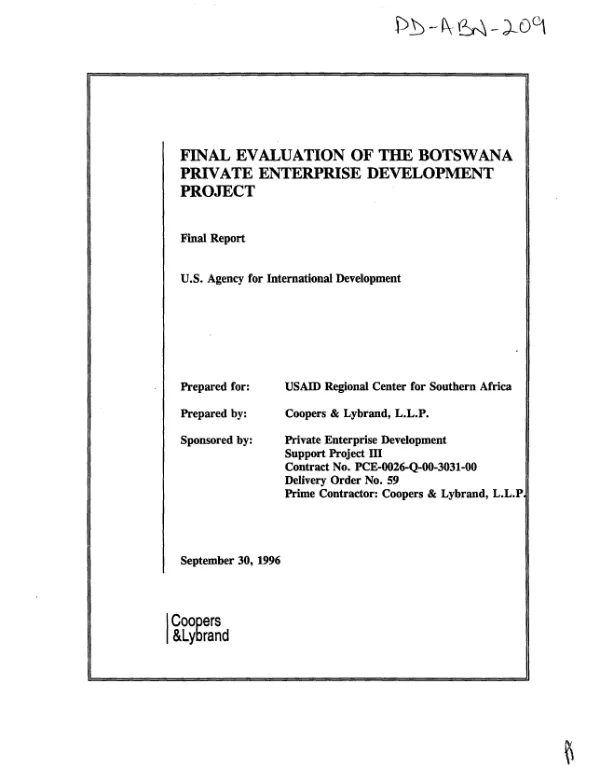
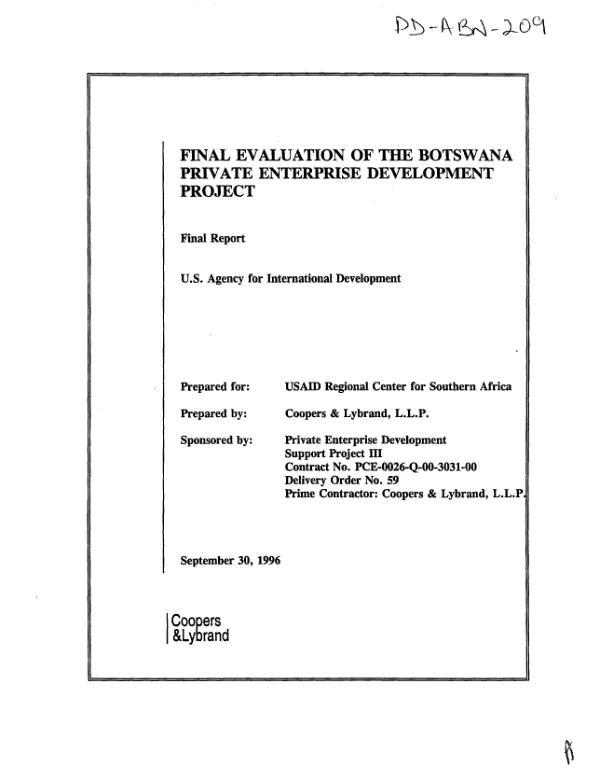
Final evaluation of the Botswana private enterprise development project -- final report
Sign inCOOPERS AND LYBRAND
Final evaluation of the Botswana private enterprise development project -- final report
Final evaluation of a project (5/91-9/96) to promote private enterprise development in Botswana (BPED project).
Manrique, Lynne; Hardy, Benjamin · 1996
Sign in to readA free account is required to download.
Abstract
The project was implemented by the Botswana Confederation of Commerce, Industry, and Manpower (BOCCIM), the Botswana Development Corporation (BDC), and the Ministry of Commerce and Industry (MCI). The project has had a positive effect on all three implementing agencies. It has profoundly affected BOCCIM, making it a credible policy analysis organization. Its impact on MCI has been positive in terms of skills training and development of a database for policy development, although its effect on the Ministry"s Department of Industrial Affairs (DIA) is uncertain due to frequent DIA staff changes. As for BDC, its relatively continuous involvement in the project has enabled it to achieve significant improvement of skills. Because BDC is larger than either BOCCIM or MCI, project advisors have been able to transfer their expertise to many BDC staff, not just to official counterparts. Policy development activities have included issue-based meetings, which allowed participants to identify policy issues and develop activities to address them; these meetings initially focused on the three implementing organizations but were expanded as the project progressed. The development of this process of collaborative policy discussion is a significant achievement. Other successful policy development approaches included (1) use of funding to catalyze activities that were subsequently assumed by the three implementing organizations or other entities; (2) BOCCIM"s active involvement of its members in planning and implementing activities or policy positions. The two weaknesses of the project"s approach -- failure to pursue the participation of legislative draftspersons in financial sector development working groups and BOCCIM"s failure to gauge adequately the resources needed to conduct activities -- were minor in comparison. However, while many project activities became the basis for policy dialogue between the Government of Botswana (GOB) and the private sector, this dialogue has seldom led to policy reform. Several important policy proposals await decisions, but the only reforms actually implemented are tax reduction, some liberalization of interest rates, and the first round of foreign exchange liberalization. These are substantial improvements over previous policies, but they are partial reforms that leave much to be accomplished. In sum, Botswana is moving steadily toward an enabling environment for private sector development, due in no small part to BOCCIM"s work in improving communication and understanding between the public and private sectors. The crucial question with respect to sustainability is whether BOCCIM will continue to be able to do its own research and analysis. BOCCIM has implemented most of the structural changes recommended in a 1994 organizational strategy review and should be close to breaking even financially by the time project funding ceases. The following lessons were learned. (1) A clear transition plan should be developed early on, including sequenced declines in USAID budgetary support. (2) Advisors should be expected to assume both "line" and purely advisory functions, with the balance between these functions dependent on the host-country organization, counterparts, and advisors. (3) Project advisors and managers must exercise diplomacy, especially in working with counterparts to promote ownership. (4) The project succeeded not only because USAID financed studies, but also because the GOB and the private sector learned to cooperate and to differ amicably about how policies should change. (5) USAID should try to ensure that both government and the private sector recognize the importance of continuing policy research, analysis, and dialogue after the project ends. (6) The entity responsible for drafting implementing legislation and regulations related to a policy (e.g. the Attorney General"s Chambers in Botswana) must be included in all stages of policy development in order to facilitate implementation of policy agreements reached by government and the private sector. (7) USAID funding of an institution"s activities may create high expectations among the organization"s members, and may cause dissatisfaction or confusion if such activities cease after USAID funding ends. (8) USAID"s plans regarding assistance to an organization must be made with a clear understanding of the leadership"s and staff"s goals for the organization. (9) Efforts should be made throughout the project to promote ownership of activities so that they continue (even in modified form) after USAID funding ends.