USAID DEC
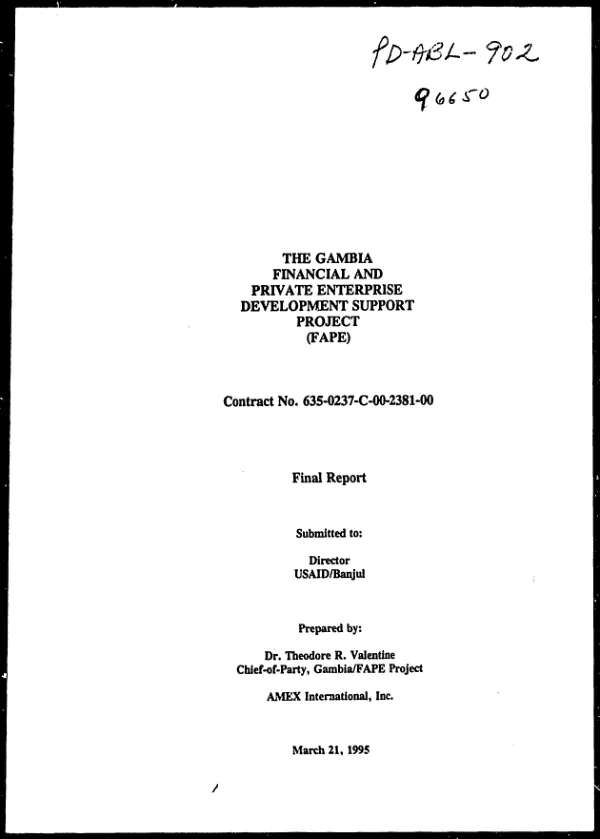
The Gambia : financial and private enterprise development support project (FAPE) -- final report
Sign inAMEX INTERNATIONAL, INC.
The Gambia : financial and private enterprise development support project (FAPE) -- final report
Final report of the contractor, Amex International, Inc., on a project to strengthen the capacity of The Gambia"s Ministry of Finance and Economic Affairs (MFEA) to undertake economic and financial analyses supportive of policy reform in the area of private enterprise development (FAPE project).
Valentine, Theodore R. · 1995
Sign in to readA free account is required to download.
Abstract
The project began in 10/92 and was terminated prematurely in 1/95 when The Gambian government was overthrown by the armed forces. Section I covers (1) the project"s status in four key intervention areas described in the revised action plan of 8/93 (macroeconomic model building and forecasting, macroeconomic and fiscal policy simulation and analysis, tax policy and government revenue policy matters, and macroeconomic and fiscal policy monitoring); (2) completed work in capacity-building in the Ministry, including training; (3) uncompleted work; and (4) possible alternatives for accomplishing the contract objectives at a future time. Section II provides lessons learned about working in The Gambia and about the design and implementation of USAID activities. (1) The FAPE project tried to address criticisms of its predecessor, the Economic and Financial Analysis Project (EFPA) by working closely with Gambians to enhance local ownership and increase motivation, providing good on-the-job training, and promoting capacity-building. Positive results were found in two key areas: development of macroeconomic models and improved analysis; and adoption of the Tax Reform Action Plan (TRAP). (2) Constraints to project implementation included lack of suitable office space and working conditions, as well as inadequate coordination, cooperation, lines of communication, and division of responsibilities. Invariably, these constraints led to confusion, miscommunication, and sometimes unnecessary turf battles. Other problems includes delays in conducting in-country training workshops due to difficulties in releasing junior and mid-level personnel; and increased responsibilities of and assignments given to the AMEX team on matters which sometimes fell outside the project"s Action Plan, although within the overall design or intention of capacity-building. (3) Resident technical advisors" scopes of work included reporting on the project and certifying that the Government of The Gambia (GOTG) was meeting the conditions for the release of funds. As a result, the advisors were perceived as not protecting the interests of the GOTG; once this idea took hold they were never integrated into the MFEA. As a result, they were unable to show the leadership or mentoring needed for effective capacity building. (4) Except at the junior and administrative personnel levels, there was little interest in the project"s training or capacity-building efforts, which did not include overseas training and the financial benefits that generally attend it. This lack of incentive, which stems from the grossly inadequate wages paid to civil servants and from the fact that length of service, not training or job efficiency, is the major determinant of promotion, was exacerbated by the lack of incentives in project training itself, which consisted of a few hours or a few days away from the job without per diem. (5) The project might consider lessons learned from similar, more successful AMEX projects in other countries. In the Botswana Workforce and Skills Training Project, the Mission would not provide an advisor unless the Ministry clearly delineated roles and responsibilities, named counterparts, and provided adequate office accommodations. In Guyana, the Ministry of Finance required junior economist/planners to attend training programs.
![Assistance for trade reform [ATR] : final report](https://covers.devme.ai/gen/43672.webp)
![Report on the activities of the IPC [implementing policy change] project in Guinea-Bissau](https://covers.devme.ai/gen/36383.webp)