BASIC HEALTH MANAGEMENT INTERNATIONAL (BHM)
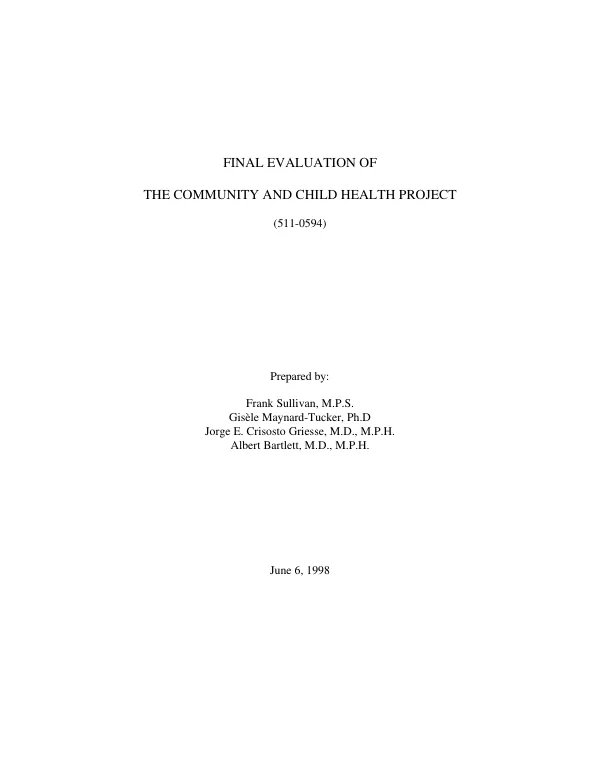
Final evaluation of the community and child health project
Final evaluation of a project (10/88-12/98) to improve access, coverage, and sustainability of an integrated package of community and child health (CCH) interventions in selected rural areas of Bolivia.
Sullivan, Frank; Maynard-Tucker, Gisele · 1998
Sign in to readA free account is required to download.
Abstract
Key findings are as follows: (1) MOH facilities in CCH areas (and likely elsewhere) are not well used because of problems with access by the rural population, low-quality service, cultural barriers, few women in positions of leadership, poor motivation of MOH personnel, and inadequate provision of medicines. (2) CCH has a burdensome and unresponsive administrative structure. Centralized decisionmaking and control is no longer appropriate. (3) The project has made important advances in improving health through its support of health information, education, and communication (IEC). However, the project appears to have had a relatively weak strategy for working with communities. (4) Due to CCH"s unfortunate evolution into a near-autonomous entity separated from the MOH, and the establishment of much higher salary scales for CCH staff compared with the MOH, the sustainability of many project accomplishments is doubtful. Important CCH successes, most of which are replicable, include: functioning of a nearly self-sufficient rotating fund for essential medicines; establishment of good departmental teams of rural educators; good educational methodology at the community level; decentralized training in one project area and early, good training in integrated management of childhood illnesses (IMCI) in two other areas; good project relations with the Ministry of Health (MOH) at the district and health-post level; good relations with the new mayors and the decentralized municipal structure; good staffing of regional (departmental and district) CCH teams; appropriate use of resources in providing items such as motorcycles and cold-chain equipment; good innovation in designing simplified administrative forms and procedures; a good example of water system follow up in one area; and good pilot activities in the Agua Claro project. Key weaknesses included the following: (1) The reproductive health add-on came too late to accomplish anything significant, as did the geographical expansion to 11 districts. (2) Program modifications based on data analysis are sporadic. (3) Few CCH financed workshops have received meaningful follow up. (4) IEC staff have not been proactive in seeking other important IEC actors such as UNICEF. (5) CCH staff seem to have been largely uninvolved in providing technical (medical) supervision to MOH staff. (6) There is little sharing between CCH departments, and much program fragmentation exists. (7) Relatively little attention has been paid to training auxiliary nurses and promoters, activities directed at the community and at nutrition issues. Also, there is little local CCH initiative, and staff response is slow to incipient area emergencies. (8) In some areas, the relationship between the CCH department head and the MOH is strained. (9) CCH has only sporadically worked with NGOs and the private sector. (10) CCH Head Office staff lack vision regarding the role of training supervision and do not often travel to areas of difficult access. (11) Many training events are overly didactic. (12) Lessons learned from the Agua Claro project have not been adequately used. (13) No thought has been given to a phase-out strategy. More specific findings are as follows: (1) While CCH has made important contributions to the country"s health management information systems (HMIS), a number of issues remain to be dealt with, especially inadequate analysis of the information gathered, a complacency with data known to have weaknesses, and the use of activity rather than impact indicators. (2) The CCH project has not given much attention to perinatal and neonatal survival. Further efforts to increase immunization coverage are also needed. (3) CCH"s indicators in child growth monitoring are not likely to have an impact on child nutrition. The quality of CCH"s intervention in iron sulfate supplementation is suspect. Similarly, the attention paid to vitamin A supplementation was probably inadequate. (4) The water component filled a great need and is highly sought after. This component provided a vehicle for the kind of grassroots effort that represents the best of development theory and practice. (5) The CCH-managed budget has been significantly underexpended for much of the life of the project. (6) CCH piggyback activities filled a great need but placed a considerable management burden on USAID. The current project should close as scheduled and a new project with a similar goal and purpose should be designed. Strategies should be different, however, and should emphasize real community participation, decentralization and municipal buy-in, and eventual sustainability. New technical areas are recommended: IMCI; reproductive health and reduced maternal mortality; business management and training; water and sanitation; and Chagas" disease, malaria, and tuberculosis. The new project"s geographical scope should be reduced and cover no more than seven districts. The MOH should be encouraged to fully staff district and department teams and implement several other pilot activities called for in the Minister"s new Strategic Plan.