BASIC HEALTH MANAGEMENT INTERNATIONAL (BHM)
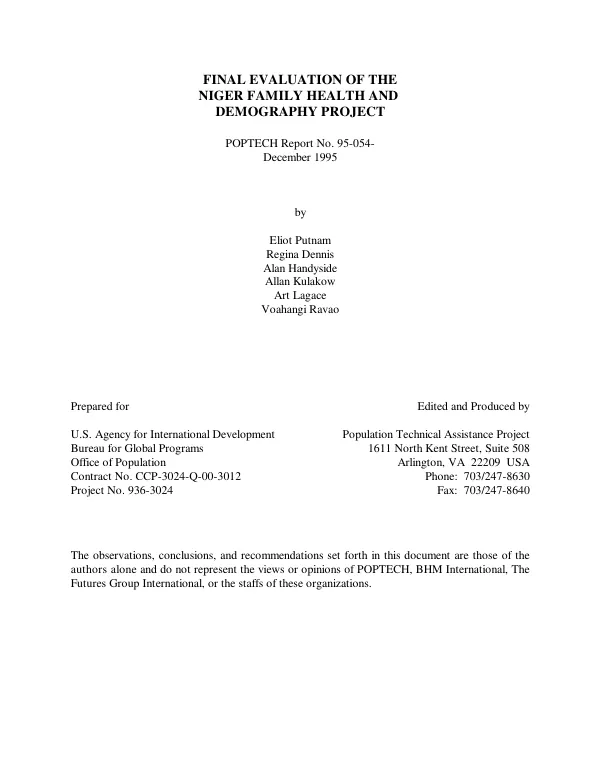
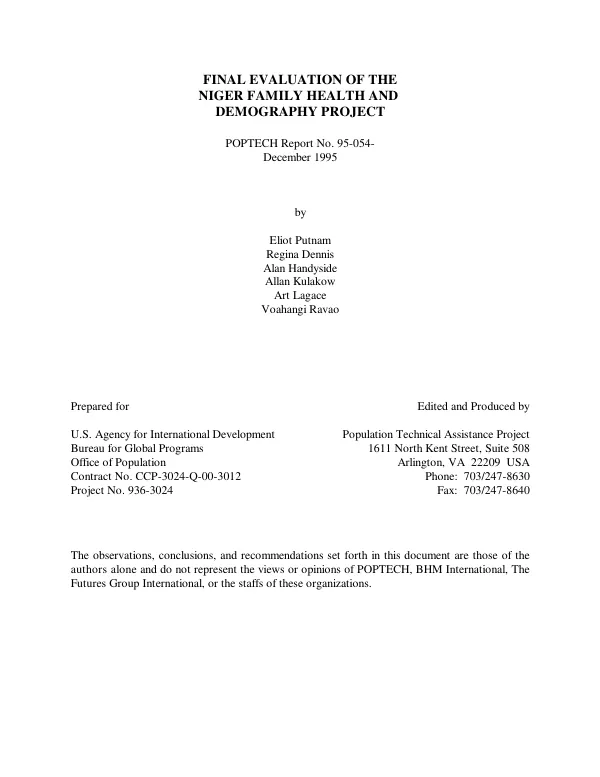
Final evaluation of the Niger family health and demography project
Evaluates two projects to strengthen Niger"s health sector: (1) the Niger Health Sector Support Grant (NHSSG), a program/project to support policy and institutional reforms (1986-96); and (2) the Niger Family Health and Demography Project (NFHDP), to expand family planning (FP) programs and demographic research (6/88-96).
Putnam, Eliot; Dennis, Regina · 1996
Sign in to readA free account is required to download.
Abstract
Results were mixed. The NHSSG, especially the portion funded with nonproject assistance, was slow to develop due to expectations which were both unrealistic and poorly understood. A mid-course reduction and clarification of policy reform objectives resulted in some successes, including development of a national health information system and nascent systems for cost recovery and cost containment in hospitals, other health facilities, and drug distribution. The NHSSG furthered the debate on a national population policy and supported the decentralization of health services management. The NFHDP also contributed to decentralization by testing service delivery models and strategies, promoting social marketing and other modest private sector initiatives, and enhancing operations research. Nonetheless, national service standards remain far from acceptable in quality and coverage. Information, education, and communication (IEC) efforts have been largely ineffectual, and poor communications at all levels have limited the sharing of effective interventions. Unpredictable events, ranging from labor strikes to currency devaluation to a meningitis epidemic, were significant hindrances to both projects. Equally damaging was the lack of effective coordination between the NHSSG and the NFHDP. Efforts on all sides notwithstanding, operating two complex projects concurrently was overly taxing on available systems and personnel in Niger, and effective synergy between the two was not fully realized. Nonetheless, the two projects have helped to bring Niger to the beginning of a new stage in the development of its national health systems and infrastructure. While still fragile, the elements of a decentralized health management system are in place. Valuable lessons have been learned from trials of service and management models, which could, with improved communications, be used nationwide. While not deep, the pool of technical talent is of good quality, providing a sound base for expansion. Finally, motivation among decision makers is high, especially when they feel confident that funders are committed to true partnerships and building Nigerien capacity. The evaluation recommends continued nurturing, with TA and targeted budgetary support, of initiatives that are critical to the development and maintenance of a decentralized health system, i.e., of a national health information system, cost recovery at all levels, national population policy dialogue, demographic analysis, and operations research. Efforts should be redoubled in areas critical to expanding access to and quality of services. This means increased attention to the skills, attitudes, and supervision of service providers; reorientation of IEC to support national capacity building and community orientation; continued improvement in contraceptive logistics; and expansion of social marketing, along with its integration into the public health system. Efforts to mobilize private sector participation in health services should be vigorously expanded. Future use of nonproject assistance as a funding mechanism should be weighed carefully; it should probably be used only to support implementation of policy reforms already adopted, until the government"s capacity to deal with more complex schemes in enhanced. In any case, all USAID support to Niger in the health and population sector should be offered under a single umbrella funding mechanism. Finally, careful and focused attention must be given to donor coordination. USAID can set an important example by establishing rigorous interagency coordination mechanisms and standards for those organizations that use its funds and by ensuring close and continuous communications with the government. By clarifying its own programmatic priorities, USAID has positioned itself to play a lead role in developing an effective, forward-looking partnership between the international donor community and the Government of Niger. No effort should be spared in moving this partnership forward. Niger is at a point of great opportunity for strengthening its health systems; the country must have success in the near term or a still fragile opportunity could evaporate. Failure to build vigorously on the steps taken under earlier projects would have serious consequences in terms of dwindling external support and further eroding the health care available to the people of Niger. (Author abstract, modified)